

When working on bulk apparel production, buyers often need buttons that look natural, remain stable across batches and are easy to control in large quantities. MOP offers a clear premium feel, and Abalone has a more decorative surface, but for many practical production orders, Trocas is a material worth considering.
From a garment accessories sourcing perspective, Trocas shell buttons are suitable for bulk apparel production because they offer the natural look of shell buttons, good durability and better production stability. However, buyers still need to check size, thickness, finish, QC standards, MOQ, lead time and reorder planning before approving bulk orders.
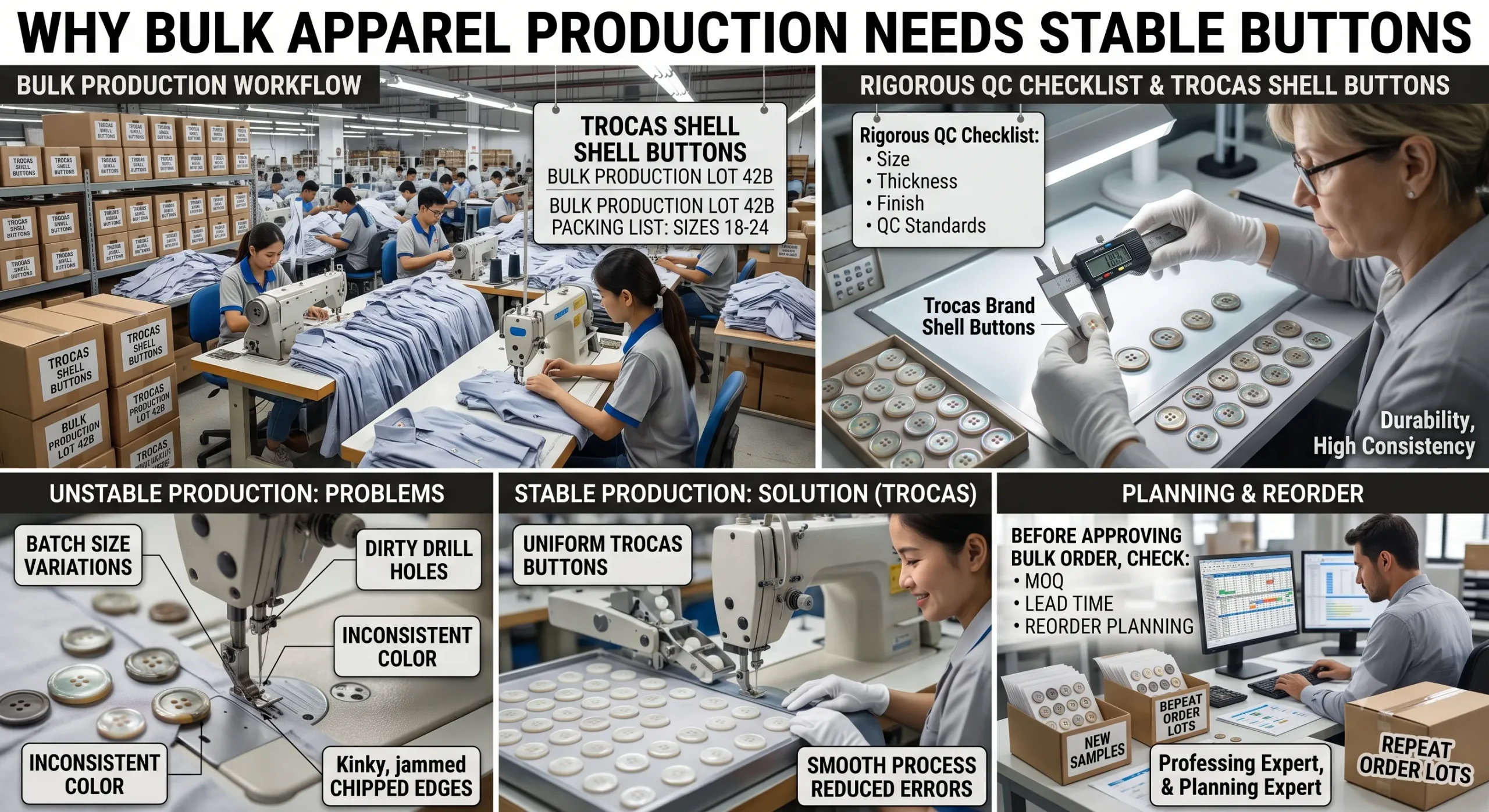
Why bulk apparel production needs stable buttons
In small orders, a few minor differences between buttons may not create a serious issue. But in orders involving tens of thousands or hundreds of thousands of garments, small differences can become real production problems.
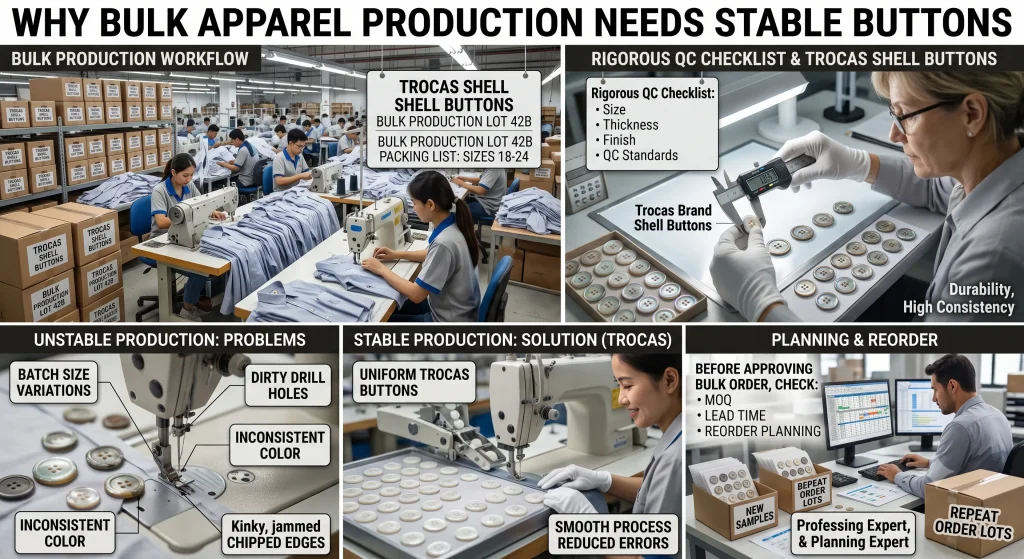
If the button size varies between batches, the sewing line may slow down. If the holes are not drilled cleanly, sewing operators may need more time to handle them. If color and finish are inconsistent, the finished garment may look uneven. If the button edges chip easily, defect rates during sewing and packing can increase.
For bulk apparel production, buyers do not only need a nice button sample for approval. They need a button material that can be produced consistently, packed clearly, delivered on schedule and used again for future reorders.
This is why Trocas is often considered by garment factories and buying houses that are looking for bulk shell buttons for shirts, uniforms, casual apparel or repeat production programs.
What are Trocas shell buttons?
Trocas is a shell material commonly used in natural shell button production. Compared with some shell materials that have stronger variation, Trocas often feels cleaner, more solid and more practical for large-volume orders.
The surface of Trocas has a natural shell look without being too showy. With the right finish, it can look neat, softly bright and easy to match with many types of apparel. This is useful when buyers need buttons for different garment styles, fabric colors or sizes within the same season.
For orders that require stability, Trocas is often easier to control than some shell materials with stronger color or pattern variation.
Why Trocas works well for bulk apparel production
More stable for large-volume production
One of the biggest advantages of Trocas is stability. In mass apparel production, stability is sometimes more important than having a button that looks very decorative.
A button sample may look beautiful on the table. But if the bulk order shows too much color difference, inconsistent thickness or finish problems, the buyer will face risk. Trocas is often a more practical choice for orders that require consistent quality across multiple batches.
For example, a brand producing casual shirts with seasonal reorders needs buttons that can keep a similar look and feel over time. If the first batch looks good but the next batch varies too much, the product image becomes difficult to maintain.
Suitable for many apparel categories
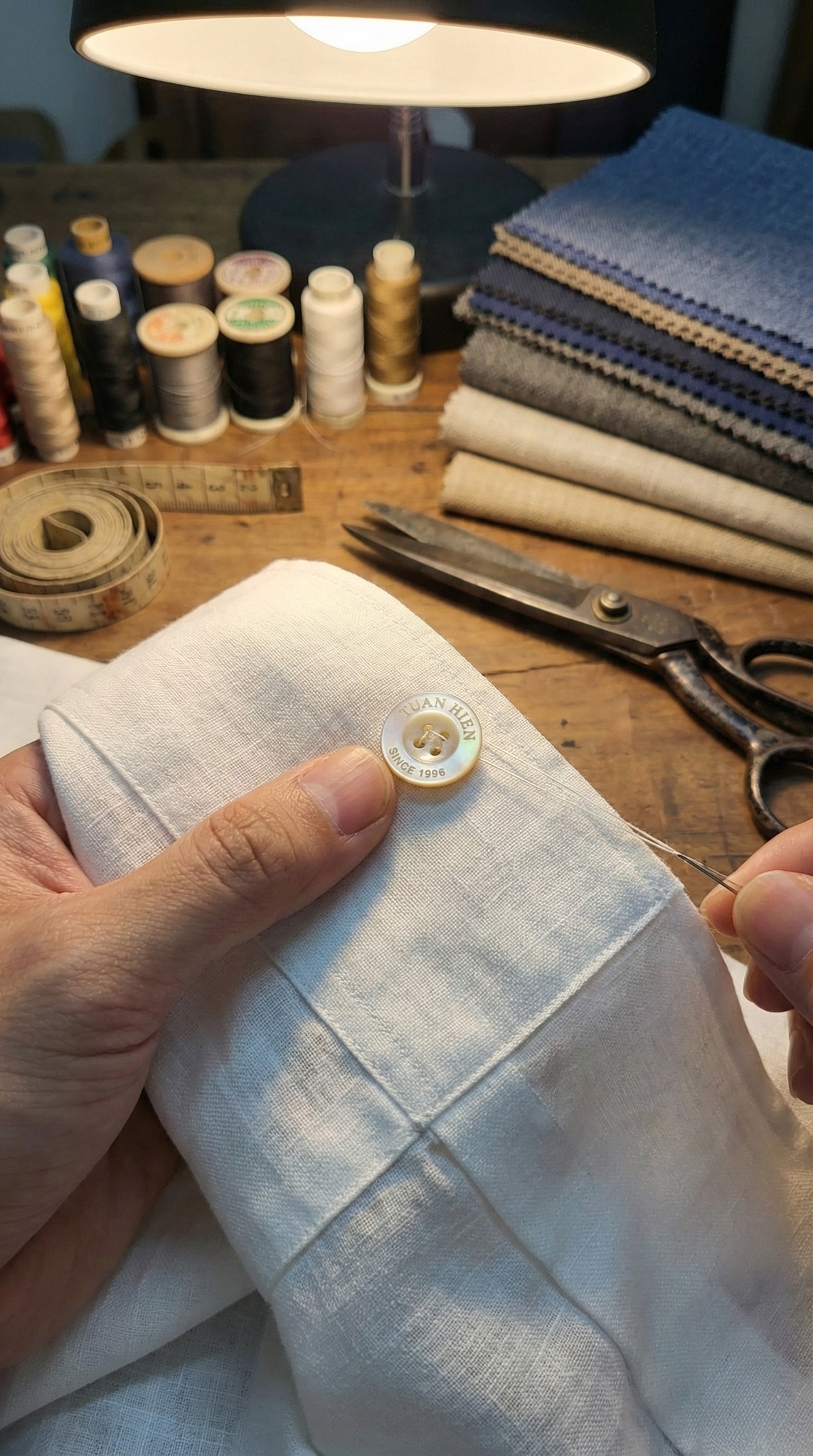
Trocas is not used only for shirts. It can also work for casual shirts, uniform shirts, knitwear, lightweight jackets or other apparel products that need a natural button look while still requiring cost and timeline control.
For product lines that do not require the deep pearlescent shine of MOP, Trocas is a practical option. It still keeps the natural feel of shell buttons, but it is often easier to bring into bulk production.
If buyers are looking for bulk shell buttons for different apparel categories, Trocas should be tested early during the sample stage.
A good balance between appearance and production
In accessories sourcing, one practical question always comes up: the sample looks good, but can it be produced consistently?
Trocas often answers that question well. It is not too showy, but it is clean and natural enough for many apparel products. For brands that need stable production, lower defect risk and easier order management, this is a meaningful advantage.
How is Trocas different from MOP?
MOP is often selected for products that need a stronger premium feel, especially dress shirts, luxury shirts or premium cotton shirts. MOP has a soft, deep and elegant pearlescent shine. But because it is a natural material with its own variation, buyers need to control color tone, shine and surface quality carefully when ordering in large quantities.
Trocas is more practical for bulk production. It is suitable when buyers prioritize stability, durability and repeatable production quality. For casual products, uniforms or reorder programs, Trocas is often easier to manage.
In simple terms, MOP is suitable when the brand wants to push a more premium look. Trocas is suitable when buyers need a stable shell button solution for large-volume production.
There is no single correct choice for every order. The right material depends on product positioning, price segment, QC requirements and production planning.
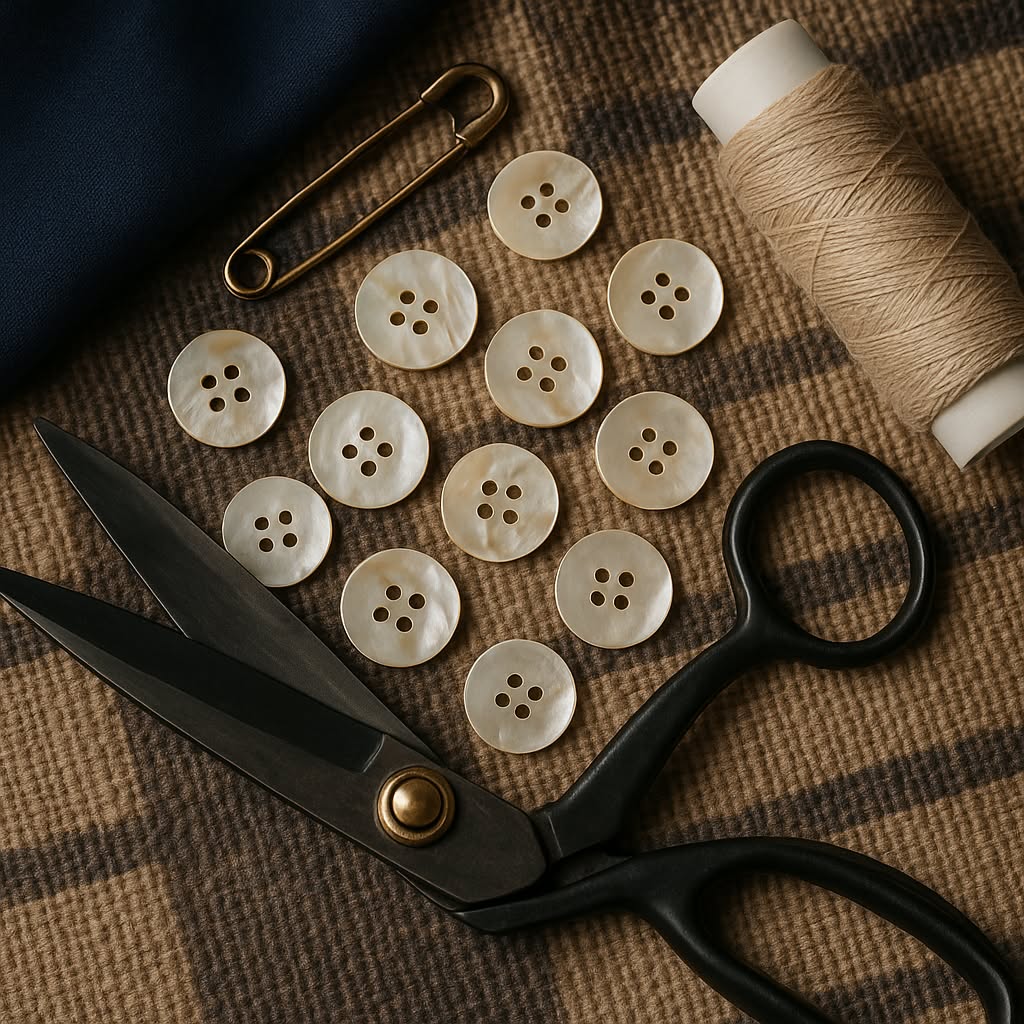
What should buyers check when choosing Trocas buttons?
Button size should be clear from the beginning
Size directly affects sewing efficiency and the final garment feel. If the size requirement is unclear, the supplier may follow a similar sample, but it may not match the final product.
For shirts, the button should match the placket. For uniforms, the button needs to be easy to fasten and durable. For knitwear or lightweight jackets, buyers also need to consider fabric thickness and button weight.
Buyers should mention the size clearly in millimeters or ligne in the RFQ. If an old sample is available, it is better to send the real sample or clear photos for reference.
Thickness should match the product
Thickness is often underestimated, but in bulk production, inconsistent thickness can affect both product feel and sewing performance.
Buttons that are too thin may feel weak. Buttons that are too thick may be difficult to fasten or make the garment feel heavy. With Trocas buttons, buyers should request a thickness that suits the garment type and button position.
If the product is a uniform or a garment used frequently, durability and a solid hand feel should be prioritized. If the product is a lightweight casual shirt, the thickness should be enough for stability without making the garment feel stiff.
Finish should be tested on real fabric
Trocas can be produced in glossy, polished, matte or other finishes depending on the requirement. But buyers should not approve finish only by looking at loose button samples.
A finish that looks good in a catalogue may not work the same way on actual fabric. When placed on navy, beige, white or light blue fabric, the feeling can change quite a lot.
The best method is to place the button on the actual fabric and check it under both natural light and indoor light. If the garment will be sold in retail stores, it is also useful to check the button under showroom lighting.
QC for Trocas buttons before bulk order approval
For large orders, QC should be clear from the beginning. It is not enough to write “good quality.” Buyers and suppliers should agree on the key inspection points before moving into bulk production.
Important points include size, thickness, hole position, edge quality, surface defects, color tone, finish consistency and packaging. For Trocas buttons, edge quality and hole drilling are especially important because they directly affect sewing performance.
If the edge is not smooth enough, the button may feel uncomfortable or affect sewing thread. If the holes are not clean or are slightly off-position, sewing speed may slow down, especially in large production lines.
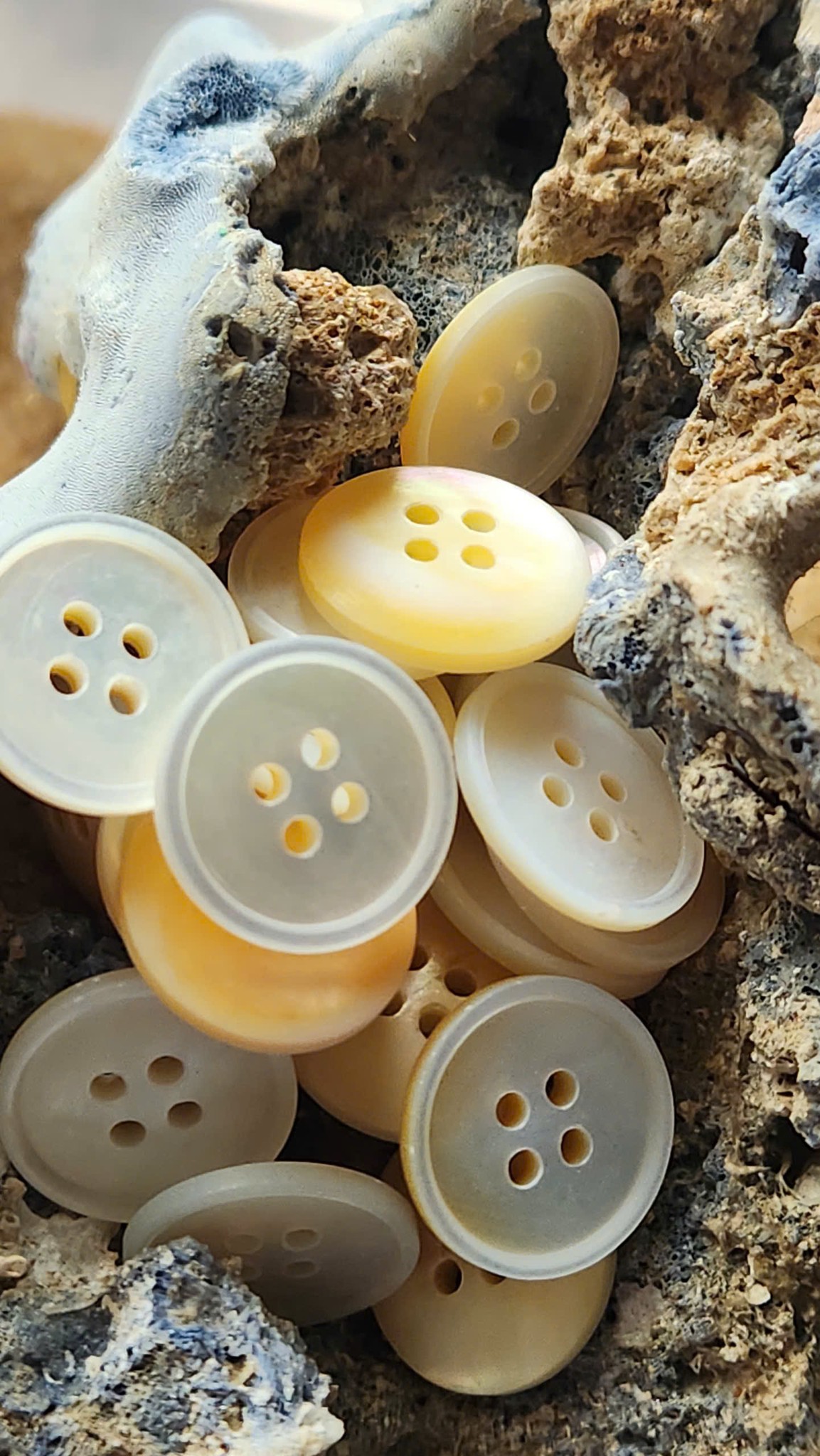
A golden sample should also be kept. This approved sample becomes the reference when checking bulk production or repeat orders. If there is any disagreement about color tone, shine or thickness, the golden sample helps both sides handle the issue more clearly.
MOQ and lead time: avoid asking too generally
When buyers ask about MOQ or lead time for Trocas, the answer depends on several factors: size, thickness, finish, quantity, customization level, packaging and delivery timeline.
A standard Trocas style with a common size and regular finish is usually easier to process. But if buyers need dyed color, logo engraving, custom thickness or special packaging, the lead time will be longer because sampling, approval and QC preparation are required.
For bulk production, buyers should calculate lead time from the sample stage, not only from the official bulk order date. If the timeline is too tight, sample adjustment can affect the whole garment production schedule.
A clear RFQ helps the supplier quote faster and more accurately. Buyers should send material, size, thickness, finish, quantity, packaging, deadline and reference images. If the product needs reorders, the buyer should also share the monthly or seasonal plan.
Reorder planning: why buyers often choose Trocas
For many brands, the first order is only the beginning. If the product sells well, the buyer will need to reorder. At that point, maintaining stable quality across different orders becomes very important.
Trocas is suitable for reorder programs because it is easier to control in many cases. Once a golden sample is approved, the supplier can use it as a reference for future batches. Although shell is a natural material, a clear sorting standard can help reduce unwanted variation.
This is practical for uniform shirts, casual shirts and product lines that are repeated every season. Buyers do not want to check every reorder as if it were a completely new sample.
An experienced Trocas buttons supplier should not only provide pricing. The supplier should also understand repeat order requirements, sorting standards, packaging and delivery schedules.
Packaging also affects final quality
Many buyers focus heavily on the button itself but overlook packaging. For shell buttons, unclear or weak packaging can lead to chipped edges, scratched surfaces or mixed sizes during transportation.
For large orders, packaging should be standardized: separate by size, separate by color, clearly show carton information, quantity per pack and item codes if needed. This helps the factory receive stock, allocate buttons to sewing lines and reduce production confusion.
If buyers have specific requirements for carton labels, packing lists or PO-based packing, these should be mentioned in the RFQ. These details seem small, but in large orders, they save a lot of time in warehouse handling and sewing preparation.
How Tuan Hien Shell Button supports buyers with Trocas buttons
For buyers looking for Trocas shell buttons for bulk apparel production, the goal is not only to find a nice button sample. The more important part is choosing the right size, thickness, finish, QC standard and packaging plan for bulk orders.
Tuan Hien Shell Button can support customers with material selection, sampling, specification confirmation, bulk production preparation, QC checking and packaging for shell button orders.
If customers need buttons for casual shirts, uniform shirts, premium apparel or repeat production programs, Trocas is a material worth considering. When the RFQ is clear, quotation, sampling and production are easier to control.

Conclusion: Trocas is practical when buyers need stability for large orders
Trocas shell buttons are a practical choice for many bulk apparel production orders because they offer a natural look, good durability and better control in large-volume production. But buyers should not choose Trocas only because it is “easy to use.” Size, thickness, finish, color tone, edge quality, hole drilling, MOQ, lead time, packaging and reorder stability still need to be checked.
A good Trocas button does not need to be overly decorative. It needs to be stable, easy to sew, suitable for the product and consistent across production batches.
Customers who need advice on bulk shell buttons, Trocas buttons or shell buttons for bulk apparel production can contact Tuan Hien Shell Button via HOTLINE: +84 283 9851258 for support based on real order requirements.


