



You send a Techpack to Asia. Three days later, you receive 10 quotations with identical product photos. Highly likely, 9 of them are from trading companies pulling blanks from the same unknown cutting workshop.
That is the naked truth of the apparel trim sourcing industry.
As someone who has worked as a Buying Agent for years, I know that the biggest fear of EU and US brands shifting their supply chains to Southeast Asia isn’t the price. It’s the fact that you don’t know who is actually holding the grinding machine for your premium shirt collection’s blanks.
Finding a direct Vietnam shell button supplier is the key to controlling risks right from the starting line.
Below is an inside view from the factory floor—the things that trading companies will never tell you in their quotation emails.
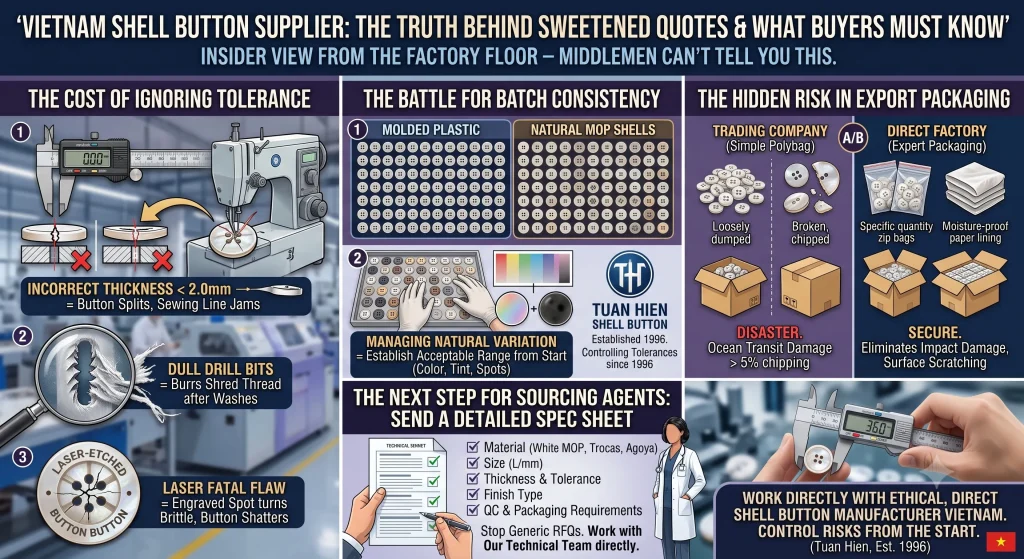
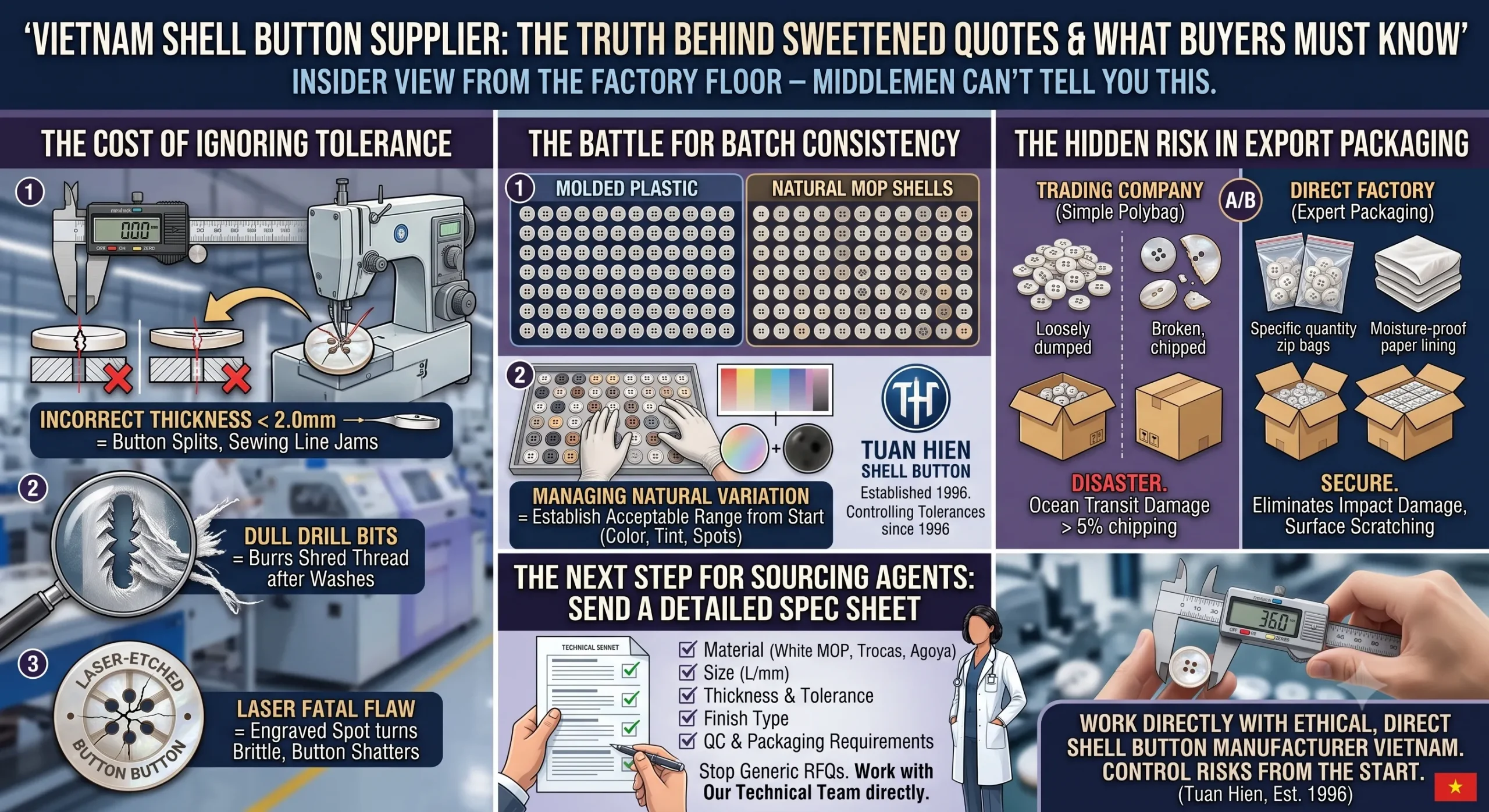
The Cost of Ignoring Tolerance
Industrial buttonhole machines don’t lie.
The needle strikes down. Crack. The button splits in two.
Thousands of shirts get jammed on the sewing line just because a batch of MOP (Mother of Pearl) buttons was ground 0.3mm thinner than the standard. Middlemen always pressure workshops to grind the button’s center thinner to save nacre (shell blanks) and optimize their margins. But an ethical, direct shell button manufacturer Vietnam will refuse that request.
An 18L (ligne) shell button used for a premium shirt must adhere to extremely strict thickness tolerance, usually stable at 2.0mm – 2.5mm.
Technical issues don’t stop at thickness. If the drilling is done with dull bits, it leaves burrs hidden inside the holes. The customer washes the shirt twice, and the sewing thread is shredded by these burrs. Or consider the laser etching depth. If it’s burned too deep, the original structure of the shell is destroyed, turning the engraved spot into a structural fatal flaw that causes the button to shatter from the center.
The Battle for Batch Consistency
Molded plastic buttons are identical by the hundreds. Natural shells are not.
When working with large brands, approving a golden sample on an office desk isn’t enough. The real challenge for a factory is how to maintain batch consistency for reorders two or three years down the line.
No factory can guarantee that 100,000 buttons will look exactly the same. The question is how they manage that variation. At Tuan Hien Shell Button, the process of establishing the acceptable range is strictly enforced from the very beginning: What percentage of yellow tint is allowed on the back? What size of natural black spot gets rejected at QC?
Only factories with deep experience (like Tuan Hien, established in 1996) possess the robust standard sample archiving and raw blank sorting systems necessary to solve this problem for Buying Houses.
The Hidden Risk in Export Packaging
The goods look flawless leaving the factory. But when the cartons are opened at the destination port, the chipping and surface scratching rate hits 5%. How are you going to compensate your end customer?
In shell buttons export, improper packaging is a disaster. Shells are very hard but extremely brittle when they directly impact each other. A bumpy 30-day ocean transit under FOB terms will crush the nacre layer if the buttons are simply dumped into flimsy polybags.
An internationally capable export factory will automatically divide the buttons into specific quantities in zip bags, line them with specialized moisture-proof paper, and tightly pack them into 5-ply export-standard cartons to eliminate any empty space for impact.
The Next Step for Sourcing Agents
Don’t waste your time sending generic RFQs like “Please quote me 50,000 shell buttons.”
Establish your expert positioning by sending a detailed technical Spec Sheet:
- Exact material (White MOP, Trocas, or Agoya).
- Size (L/mm) with required thickness and tolerance range (+/- mm).
- Finish type (Double-sided polish, or matte).
- QC control and export packaging requirements.
Send this spec sheet directly to the manufacturing factory to work directly with our technical team. We are not a trading company. We have been cutting blanks, controlling tolerances, and running production lines since 1996. Let us send real test samples right to your desk.


