

20,000 hotel uniform shirts are about to hit the sewing lines. You want to completely eliminate cheap plastic buttons. Metal buttons are heavy and rust over time. Natural materials seem like the optimal solution. But the Sourcing department immediately shuts it down: “Shell buttons will shatter under high-speed buttonhole machines. Who pays for the mass defect rate?”
This fear is justified. But it only happens when you buy the wrong blank specs.
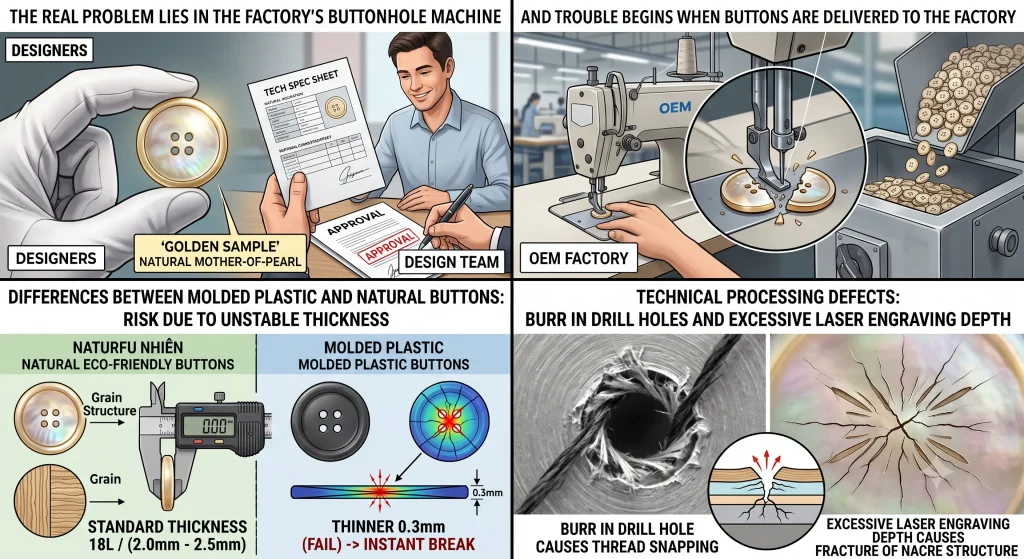
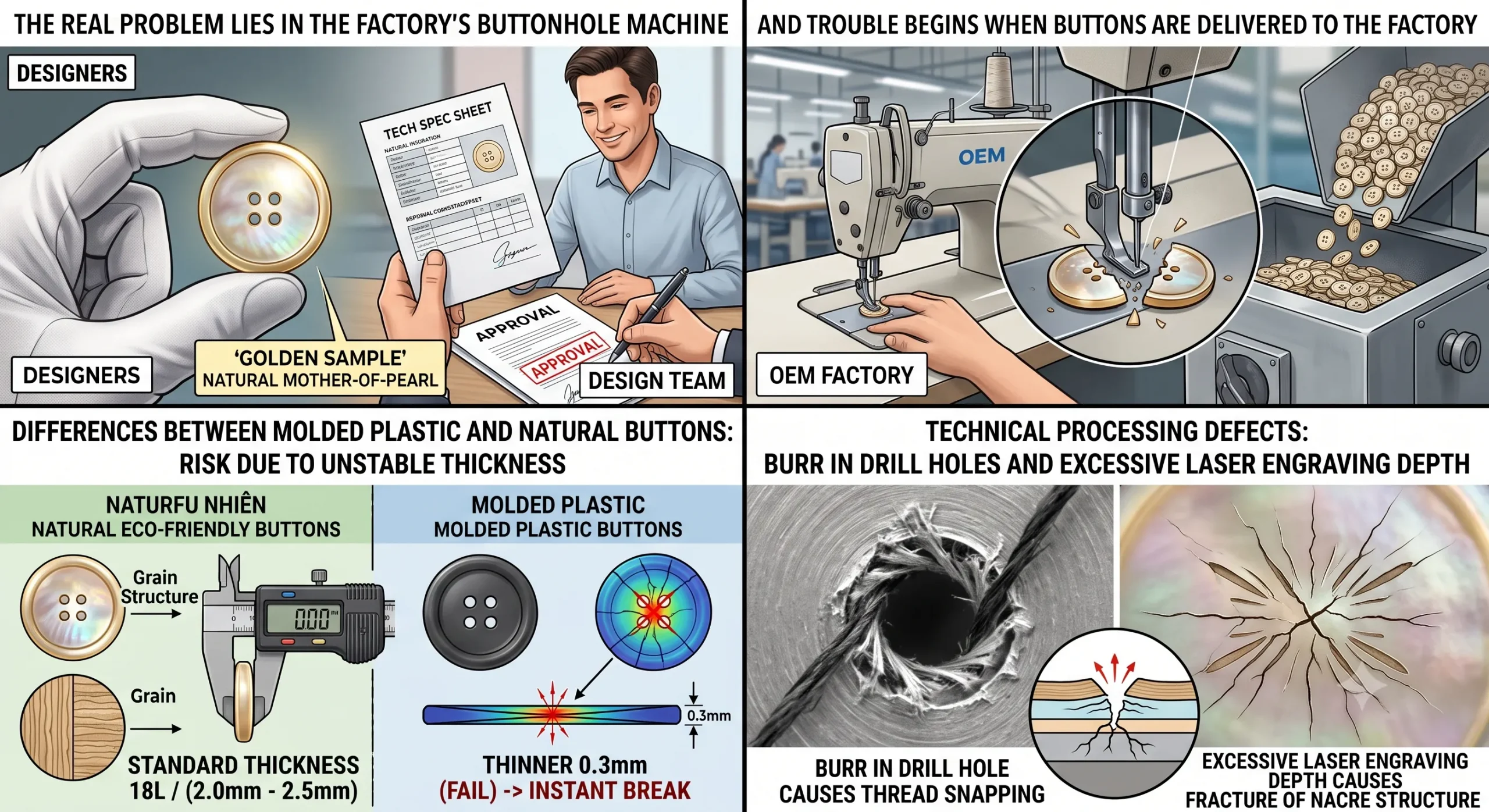
In reality, shell buttons for uniforms can perfectly withstand the harsh industrial laundering of workwear and premium uniforms. The risk of line jamming isn’t about the material itself. It depends entirely on your spec sheet and how the factory handles the raw blanks.
Thickness and Tolerance: The Life-or-Death Decision on the Sewing Floor
Molded plastic is identical by the thousands. Natural shell is not. The natural nacre layers offer superior hardness and light reflection, but they come with mechanical brittleness if ground too thin.
When fed into high-speed automatic buttonhole machines at OEM garment factories, a button will snap in half instantly if it lacks thickness. For corporate uniforms, the standard size ranges from 16L to 18L (ligne). To ensure these durable shell buttons survive, the thickness must strictly stay between 2.5mm and 3.0mm.
Trying to cut costs by dropping the blank thickness below 1.8mm is a fatal mistake. You might save a few cents on raw trim costs, but the sewing floor will pay the price with thousands of rejected shirts.
Beyond thickness, the button factory must tightly control the tolerance limit. Grind just 0.3mm too deep into the center bowl, and the structural integrity vanishes. Leftover burrs inside the drill holes? The sewing thread will shred after just a few industrial wash cycles.
Floor perspective: Skip White MOP for heavy-duty workwear. Switch to Trocas. The original Trocas shell structure is thick, and its distinct conical shape gives the blanks excellent impact resistance. Plus, the FOB price is highly optimized for bulk orders.
Reorder Planning: Fighting Color Discontinuity Over the Years
Corporate uniforms have a unique commercial nature: staff turnover. Two years after the first order, your client hires 500 new employees. The newly tailored shirts must match the old batch 100%, from fabric dye down to the buttons.
But in the natural world, no two shells are exactly alike. Nacre iridescence, dark veins, and light reflection vary heavily between harvest seasons. How do you execute a plan to reorder shell buttons long-term without color mismatches on the same placket?
The key is batch consistency and a strict golden sample sealing process.
From the very first bulk run, the brand’s QC and the factory must lock down an acceptable range. For example: the back side can have a maximum of 15% natural yellow tint, and the front face must have no deep black spots. This golden sample gets sealed in the warehouse. When the client triggers a reorder, the button factory uses this exact reference to sort the blanks right at the raw cutting stage. This kills the risk of tone mismatch before the batch even hits the mass polishing drums.
Export Packaging: Don’t Let Buttons Chip at Sea
The buttons look flawless leaving the factory. But when the buyer opens the master cartons, the chipping and surface scratching rate hits 5-7%. This defect is almost always caused by substandard packaging.
Long ocean transits mean violently bumpy containers. If the factory just dumps tens of thousands of buttons into a thin polybag and shoves them into a flimsy carton, the sharp edges will destroy each other’s nacre surfaces.
A ready-to-ship export packaging protocol is non-negotiable. Buttons must be divided into exact-quantity inner bags, lined with specialized moisture-proof paper, and secured inside rigid 5-ply cartons following international Incoterms to eliminate all empty impact space.
Structuring a B2B Uniform RFQ
A professional apparel buyer never sends a vague email: “I need to buy 50,000 shell buttons, please quote.” The vaguer the RFQ, the more weeks you waste emailing back and forth to clarify specs.
When structuring your uniform sourcing, prepare a clear Spec Sheet containing:
- Designated material: Trocas, White MOP, Black MOP, or Agoya.
- Size: In Ligne or mm (e.g., 18L, equivalent to 11.5mm diameter).
- Mandatory thickness: Minimum thickness with acceptable tolerance (e.g., 2.5mm thick, +/- 0.1mm).
- Holes and finish: 2-hole or 4-hole, flat or bowl center, polished or matte finish.
- Laser etching depth: If adding a brand logo, the laser depth must be capped so it doesn’t thin out the button’s core.
- Volume forecast: Expected frequency and quantity for upcoming quarterly/yearly reorders.
Going green with corporate uniform trims and eliminating plastic isn’t a risky gamble—if you lock down the technical specs right from the start with your supplier.
Visit the Tuan Hien Shell Button homepage or send us your collection’s current Spec Sheet. Our technical team, backed by manufacturing expertise since 1996, will audit your technical risks, advise on the optimal Trocas/MOP specs, and ship durable shell button samples that actually pass the industrial wash test straight to your office.


