


Choosing shell button size may sound simple, but in garment production, this small detail can easily cause sampling mistakes. A button that looks good in a sample box may not work well on a shirt, knitwear, uniform or premium apparel product. If the size is slightly wrong, the button placket may look unbalanced. If the thickness is not suitable, the shirt may be difficult to fasten. If the hole position is not clean and accurate, the sewing line may slow down.
That is why a clear shell button size guide helps garment buyers choose the right specifications from the beginning. For B2B orders, button size should not be selected only by feeling. It should be based on garment type, fabric thickness, placket width, button position, button material and bulk production requirements.
Why buyers should not choose button size only by eye
During sample development, many buyers choose buttons by looking at a catalogue or product image. This can be useful for the first reference, but it is not enough for final approval.
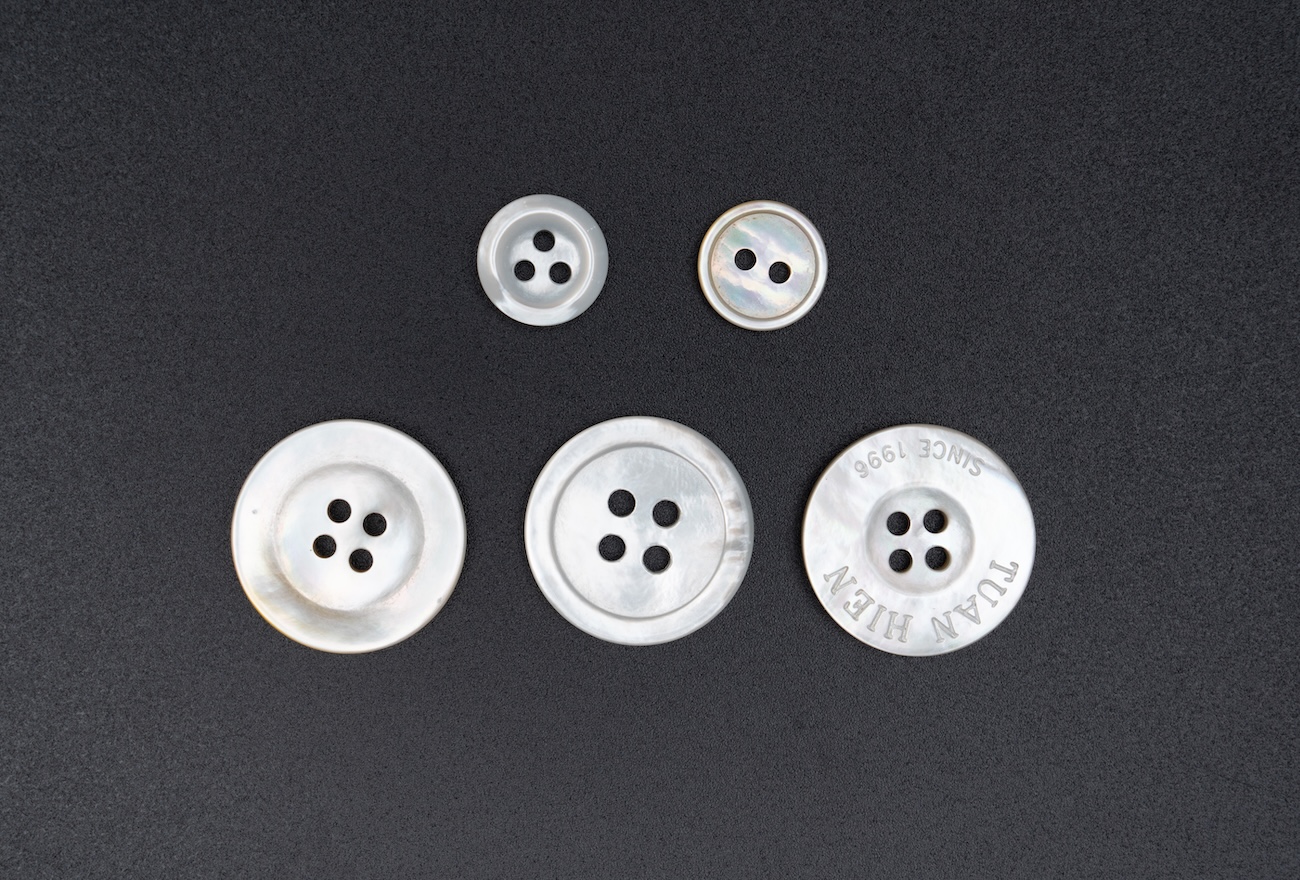
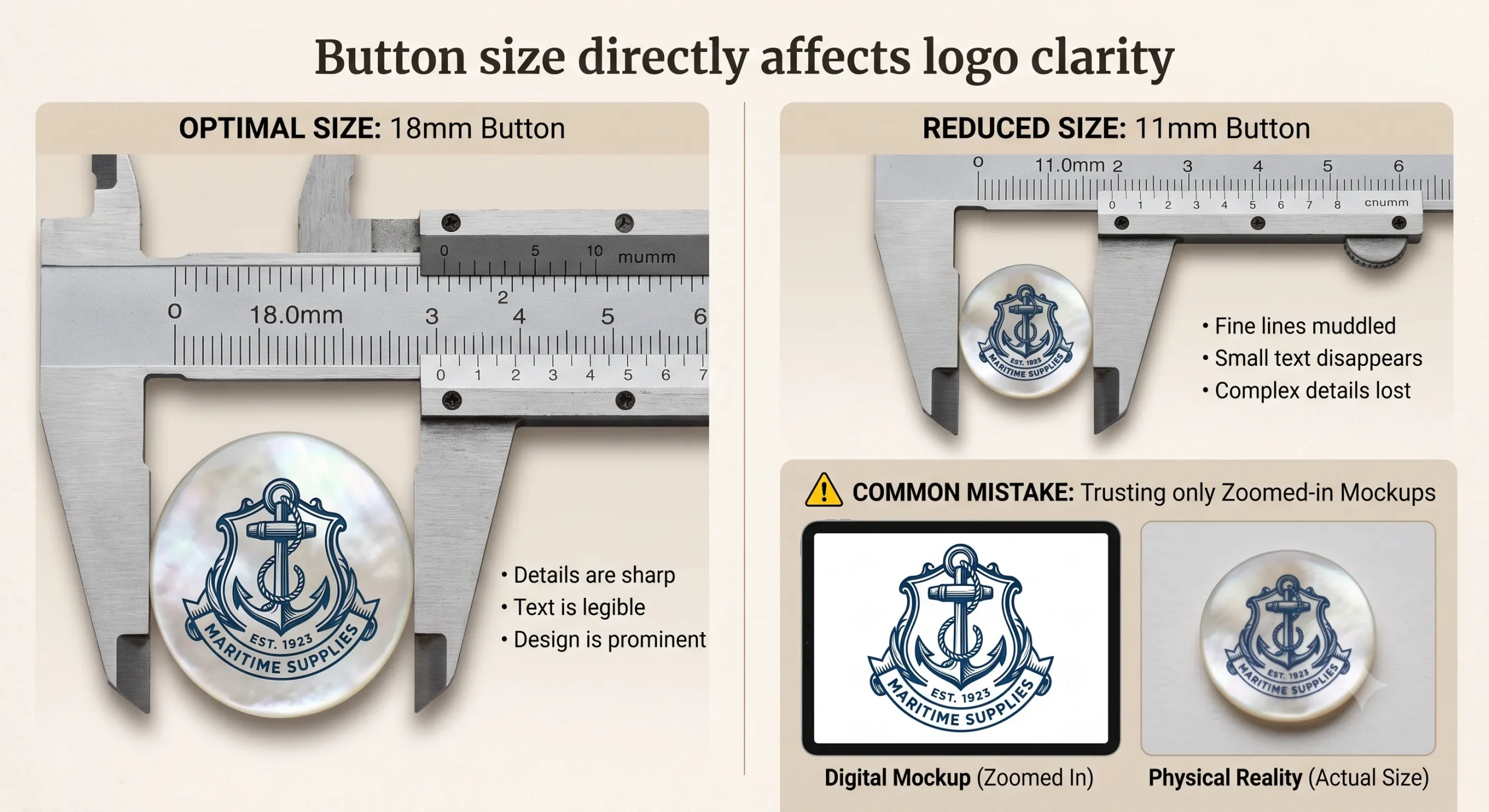
The reason is practical: a button looks different when it stands alone compared with when it is placed on real fabric. An 11.5 mm button may look suitable in a sample box, but it may appear slightly small on a men’s shirt placket. A 15 mm button may look nice on a casual shirt, but it can feel too strong on a thin dress shirt.
With shell buttons, buyers also need to consider thickness, surface finish, natural shine and fastening feel. Shell buttons are natural materials, so size and thickness should be clearly confirmed before quotation, sampling and bulk production.
If a buyer only says, “Please suggest a normal shirt button size,” the supplier can still give advice, but the result may not fully match the garment fit, brand segment or production standard.
Understanding button size units: ligne and millimeter
In the button industry, size is usually described in two ways: ligne and millimeter.
What is ligne?
Ligne is often written as L. It is a traditional unit used in the button industry. The basic conversion is:
1 ligne = approximately 0.635 mm
For reference:
| Ligne | Approximate mm |
| 14L | 8.9 mm |
| 16L | 10.2 mm |
| 18L | 11.4 mm |
| 20L | 12.7 mm |
| 22L | 14.0 mm |
| 24L | 15.2 mm |
| 26L | 16.5 mm |
| 28L | 17.8 mm |
| 30L | 19.1 mm |
| 32L | 20.3 mm |
This table helps buyers communicate more clearly with suppliers. However, when sending an RFQ, it is better to include both units if possible. For example: 18L / approx. 11.5 mm or 24L / approx. 15 mm.
Why should buyers include mm in the RFQ?
Some buyers are familiar with ligne, while some garment factories prefer millimeters. If both sides do not agree on the unit, misunderstanding can happen easily. This is especially important when one order includes different sizes for body buttons, cuff buttons, collar buttons or spare buttons.
A good RFQ should look like this:
Material: MOP shell
Size: 18L / approx. 11.5 mm
Thickness: 2.0 mm
Hole: 4 holes
Finish: polished
Quantity: 50,000 pcs
Application: men’s dress shirts
The clearer the specification, the easier it is for the supplier to quote accurately and develop the right sample.
Button size for shirts: choosing size by garment type
For shirts, button size depends on garment fit, gender, placket width, fabric type and product positioning. One size should not be used for every shirt style.
Dress shirts
Dress shirts usually need a clean, neat and refined look. Buttons that are too large can make the shirt look less elegant. Buttons that are too small can make the placket look weak, especially on men’s shirts or premium cotton shirts.
For dress shirts, buyers often consider sizes around:
16L – 20L
approximately 10 mm – 13 mm
Body buttons may use 18L or 20L depending on the design. Cuff buttons may use the same size or slightly larger, depending on the brand. For premium dress shirts, size should go together with proper thickness so the button does not feel too thin or weak.
Casual shirts
Casual shirts are more flexible. If the shirt has a relaxed fit, oxford fabric, lightweight denim, linen or thicker cotton, buyers can consider a slightly larger button size.
Common reference range:
18L – 24L
approximately 11.5 mm – 15 mm
For casual shirts, buttons can have more presence on the garment. Still, balance is important. A button that is too large may make the shirt feel heavy, especially on thin or light-colored fabric.
Women’s shirts
Women’s shirts often have a smaller fit or a narrower placket, so the button size may be smaller than men’s shirts. However, for blouses, fashion shirts or premium womenswear, the size depends on the design direction.
Reference range:
14L – 18L
approximately 9 mm – 11.5 mm
For women’s products, buyers should place the button on the actual garment sample to check the overall feeling. Sometimes a smaller button with a beautiful shell shine works better than a larger one.
Button size for cuff, collar and spare buttons
A shirt does not only have front body buttons. Cuff, collar and spare buttons also need clear specifications.
Body buttons
Body buttons are the main buttons on the front placket. This area is highly visible, so the size should match the placket width. If the placket is narrow and the button is too large, the shirt may look heavy. If the placket is wide and the button is too small, the shirt may lack balance.
Cuff buttons
Cuff buttons can use the same size as body buttons or be slightly larger, depending on the design. For men’s dress shirts, cuffs need a solid hand feel, so thickness and edge quality are also important.
Collar buttons
If the shirt has a button-down collar, collar buttons are usually smaller than body buttons. A collar button that is too large can make the collar look rough. A button that is too small may be difficult to fasten and may look unbalanced.
Spare buttons
Spare buttons should match the main buttons in size, material and finish. If spare buttons are packed separately, the packing information should be clear so the factory does not mix them with other sizes.
Shell button thickness: do not look only at diameter
Many buyers ask only about the button diameter but forget thickness. This is a common mistake.
Shell button thickness directly affects hand feel, fastening comfort and the way the button sits on fabric. An 11.5 mm button that is too thin feels very different from an 11.5 mm button with proper thickness.
When the button is too thin
A thin button may help reduce cost, but it can feel weak. For dress shirts or premium shirts, customers may notice this when fastening the button. Thin buttons can also make the garment feel less premium, especially when used with high-quality fabric.
When the button is too thick
A thick button is not always better. If used on thin fabric, it may make the shirt feel heavy or harder to fasten. On a narrow or lightweight placket, excessive thickness can make the button row feel bulky.
Thickness should match the fabric
Thicker fabric may require a more solid button. Softer fabric needs a better balance. For knitwear, buyers should also consider the drape of the garment. For uniforms, durability and a solid feel may matter more than a light and delicate look.
The right point is simple: the button should feel stable, but it should not disturb the garment structure.
Hole position: a small detail that affects sewing
Hole position refers to where the holes are drilled on the button. For shell buttons, the holes should be clean, balanced and suitable for sewing.
If the holes are off-position, the button row may look uneven after sewing. If the distance between holes is inconsistent, sewing operators may need more time to adjust. If the holes have burrs or sharp edges, the thread may be rubbed during use.
For bulk orders, buyers should check:
Number of holes: 2 holes or 4 holes
Distance between holes
Whether the hole position is balanced
Whether the holes are clean
Whether there are sharp edges or chips around the holes
For dress shirts and premium shirts, 4-hole buttons often give a more solid and refined look. But the final decision should still depend on the garment design and factory sewing standard.
Choosing size by material: MOP, Trocas, Agoya, River Shell
The same size can feel different when the material changes.
MOP buttons
MOP has a beautiful pearlescent shine and is suitable for dress shirts and premium shirts. With MOP, the button does not need to be very large to create a premium feeling. However, thickness and finish should be checked carefully because customers often look closely at premium garments.
Trocas buttons
Trocas is suitable for many bulk orders because it is stable and easier to control in large-volume production. For casual shirts, uniforms or products that need reorders, Trocas is a practical choice. When choosing Trocas size, buyers should balance appearance, durability and production stability.
Agoya, River Shell and Abalone
These materials have different surface patterns and shine. Some types have more visible natural patterns, so when used in larger sizes, the button can become a design highlight. This may work well for fashion items, but it may not suit dress shirts that require a more subtle look.
That is why buyers should check the material and size on real fabric, not only by looking at loose button samples.
How to choose size for bulk production
In bulk production, size is not only a design matter. It also affects quotation, sampling, packing, QC and production timeline.
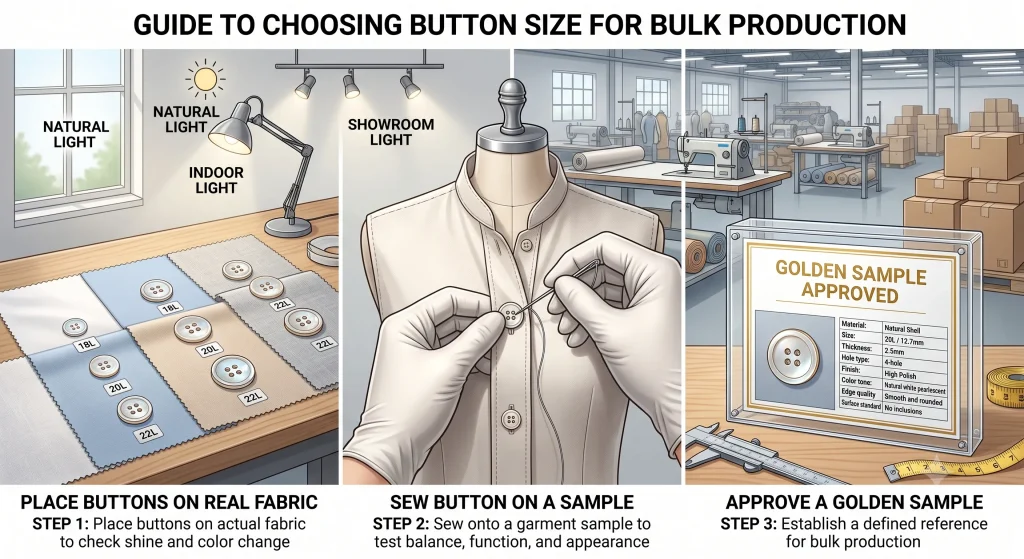
Before approving bulk production, buyers should follow three practical steps.
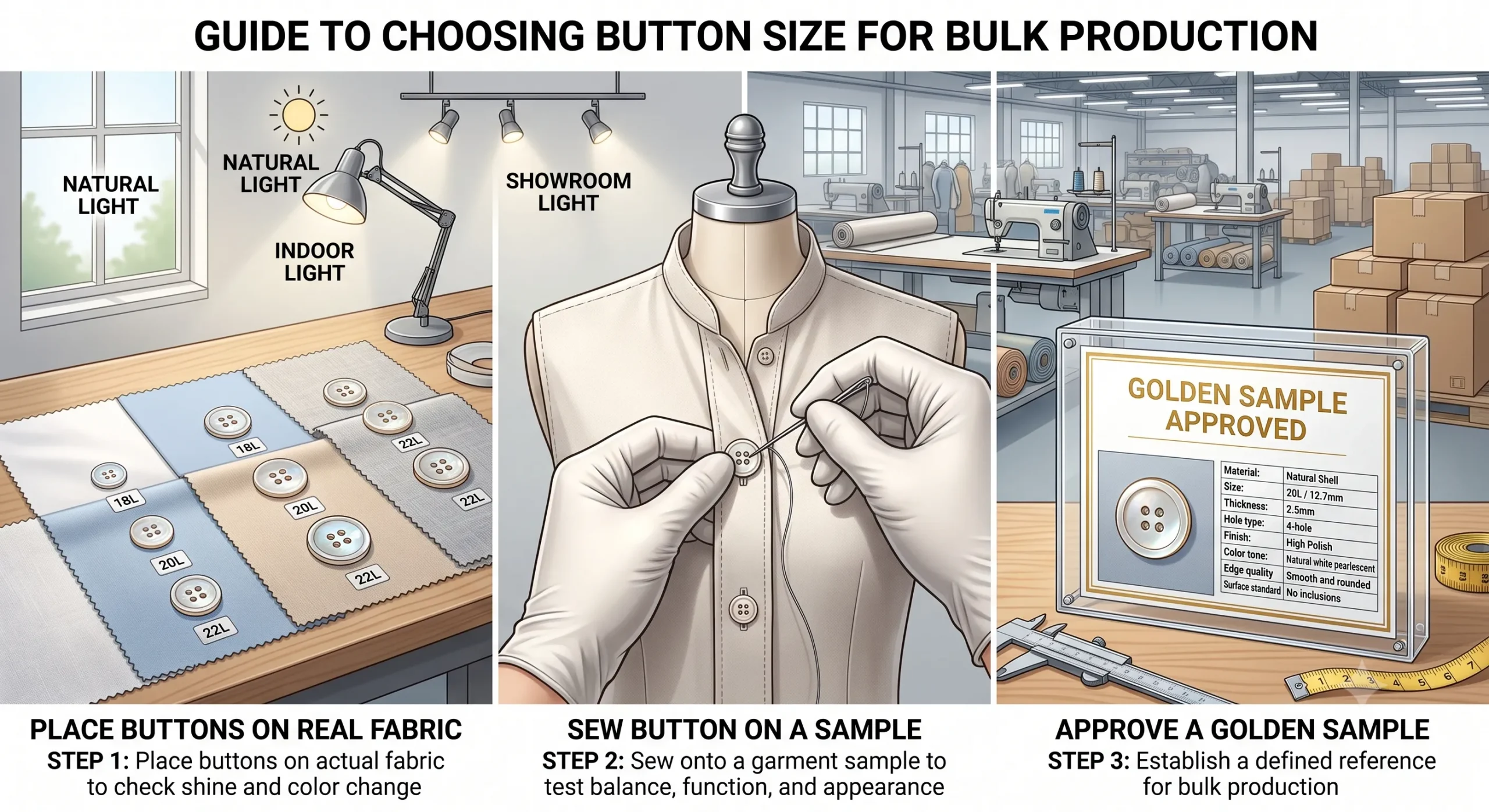
Step 1: Place buttons on real fabric
This is simple but very important. Place two or three close sizes on the actual production fabric. Check them under natural light, indoor light and, if needed, lighting similar to a showroom.
A size that looks good on screen may not work well on fabric. Especially with white, light blue, beige or light grey fabric, the shine of shell buttons can change depending on light.
Step 2: Sew the button on a sample
Do not approve the button only by placing it on fabric. It is better to sew it on a garment sample or at least on a sample placket. Once sewn, buyers can clearly see whether the size is balanced, whether the button height is suitable, whether it fastens easily and whether the button row looks neat.
Step 3: Approve a golden sample
After size, thickness, finish and hole position are confirmed, buyers should approve a golden sample. This becomes the reference for the supplier, factory and QC team during bulk production.
A golden sample should clearly record:
Material
Size / ligne / mm
Thickness
Hole type
Finish
Color tone
Edge quality
Surface standard
With a golden sample, inspection and repeat orders become much easier.
What should buyers include in an RFQ?
A clear quotation request saves a lot of time. Buyers should not only send a button image and ask, “How much is this?” Suppliers need specifications to quote and advise properly.
A shell button RFQ should include:
Material: MOP / Trocas / Agoya / River Shell / Abalone
Size: ligne and mm if available
Thickness: mm
Hole: 2 holes or 4 holes
Finish: polished / glossy / matte
Quantity: quantity by size
Application: shirts / uniforms / knitwear / premium apparel
Packaging: packing requirements
Deadline: delivery timeline
Reference sample: image or real sample if available
If buyers are not sure which size to choose, they can send product information for supplier advice. But if a tech pack or garment sample is available, it should be shared to speed up sample development.
Common mistakes when choosing button size
One common mistake is choosing size based on an old product without checking the new fabric. When fabric changes, button size may also need to change. For example, both may be shirts, but thin poplin and thick oxford fabric can feel very different with the same button size.
The second mistake is choosing the right diameter but the wrong thickness. The button may look fine in size, but if it is too thin or too thick, the final garment may not feel right.
The third mistake is not separating sizes clearly when placing the order. If body buttons, cuff buttons and collar buttons use different sizes, packing must be clear. If sizes are mixed when delivered to the factory, the sewing line can slow down or finished garments may have defects.
The fourth mistake is approving samples by photo only. With shell buttons, photos are only references. Buyers should check real samples because shine, pattern, thickness and edge feel are difficult to judge accurately on screen.
How Tuan Hien Shell Button supports buyers with button size selection
For customers looking for button size for shirts or shell buttons for B2B orders, choosing the right size should start from the real product: garment type, fabric, button position, product segment and production requirements.
Tuan Hien Shell Button can support customers with material selection, size confirmation, ligne/mm conversion, thickness advice, hole position checking, sample development, golden sample approval and bulk production preparation.
If customers need buttons for dress shirts, casual shirts, uniforms, knitwear or premium apparel, choosing the right size from the beginning helps make the bulk order more stable.
Conclusion: the right button size helps the order run more smoothly
A beautiful shell button is not enough. For garment buyers, the button needs to have the right size, right thickness, correct hole position and proper fit for the final product. Wrong size can make the shirt look unbalanced. Wrong thickness can make the shirt hard to fasten. Poor hole position can slow down the sewing line. These issues look small, but in bulk production, the cost of fixing them is not small.
The best approach is to choose button size based on real fabric, sew it on a sample, approve a golden sample and write clear specifications in the RFQ.
Customers who need advice on shell button size guide, button size for shirts or shell button thickness can contact Tuan Hien Shell Button via HOTLINE +84 283 9851258 for support based on real order requirements.


