



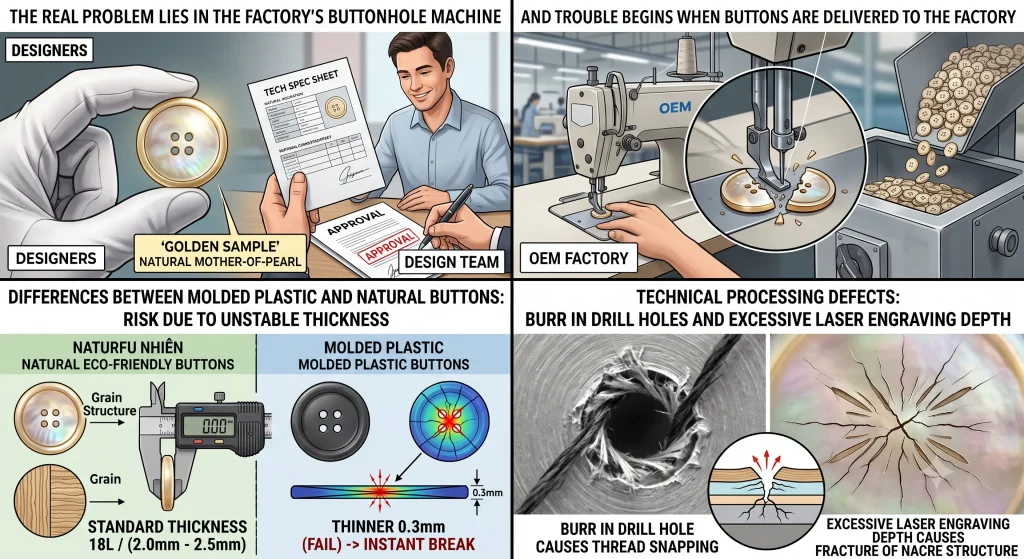
You hold a sample card of shell buttons just received from a supplier. The nacre shines beautifully under the office lights. The size looks correct. You sign the approval.
45 days later, the bulk shipment arrives at the garment factory. The industrial buttonhole machines start punching and… crack. The buttons split in half right under the needle’s pressure. The defect rate hits 10%. The entire production line jams.
This is a harsh reality that Garment Technologists and Trim Buyers face constantly. The shell button sample approval process is absolutely not an aesthetic test. It is the crucial technical checkpoint for the entire supply chain that follows.
Here is how a Sourcing expert inspects a sample before signing the approval sheet.
The Trap of Approving Samples on a White Desk
Molded plastic buttons are identical by the thousands. Natural shell buttons are not.
The blanks are cut from different shells. The inner nacre layers have inconsistent reflective structures. A common mistake designers make is placing the button sample on a pure white piece of paper under fluorescent office lights to judge its color.
From a production standpoint, this means nothing.
You must place that button directly onto the actual fabric swatch of your collection. A White Mother of Pearl (White MOP) button will flash a slight blue tint when placed on blue linen, but it will shift to a creamy tone when sewn onto a pale yellow oxford cotton. You have to observe this light interaction under both natural sunlight and warm retail store lighting before approving.
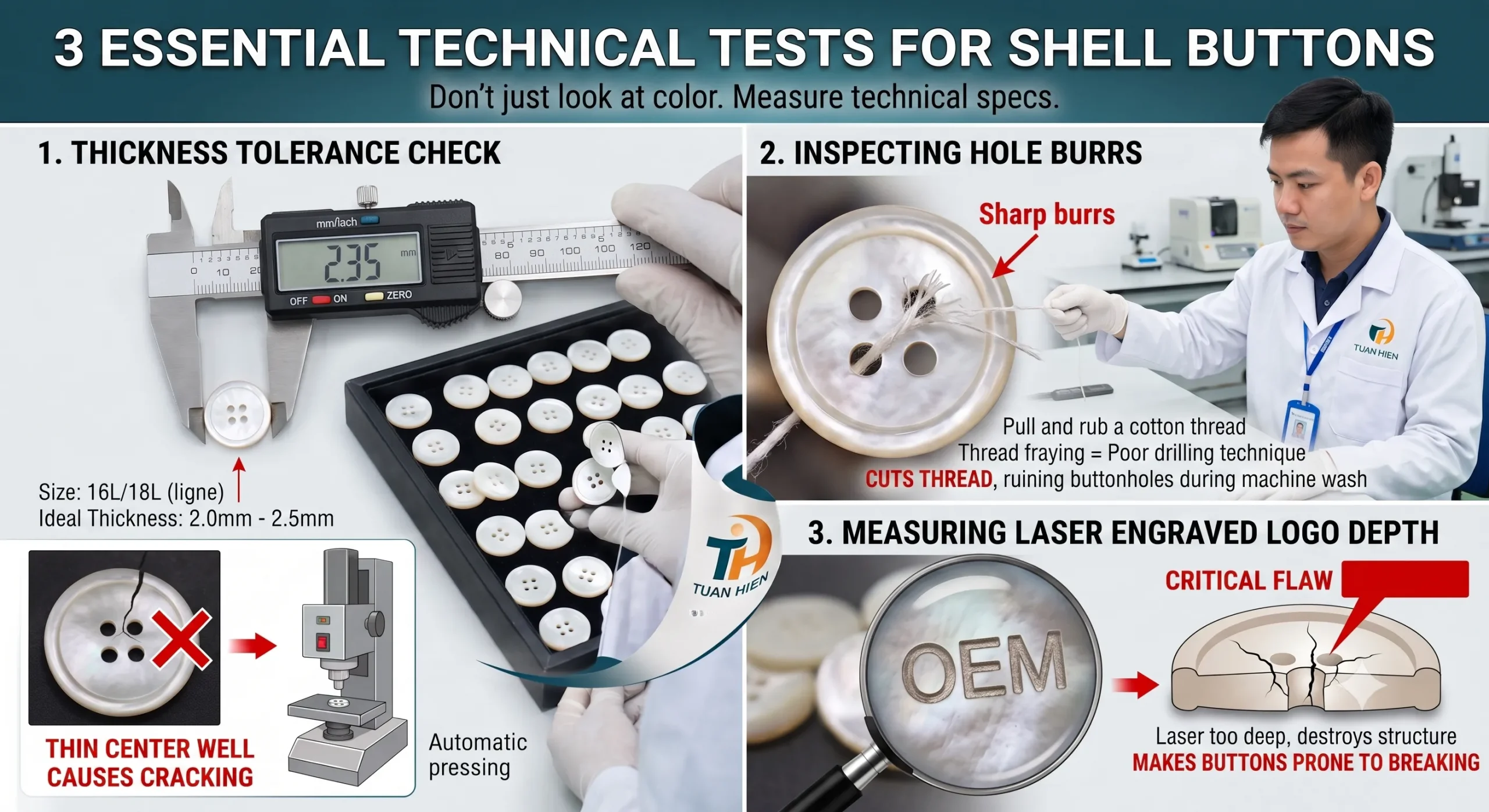
Shell Button Testing: 3 Vital Technical Checks
Color is just the surface. As soon as you hold the sample, you must switch to a strict shell button testing protocol using a digital caliper and a magnifying glass.
- Check the Thickness Tolerance A premium men’s dress shirt typically uses 16L or 18L (ligne) buttons. The ideal and safest thickness usually falls between 2.0mm and 2.5mm. Don’t just read the spec sheet—take your caliper and measure 10 random buttons on the sample card. If the thickness tolerance jumps wildly from 1.7mm to 2.3mm, reject this supplier immediately. Grinding the blanks too thin at the center bowl is the exact culprit that causes buttons to shatter inside the automatic pressing machines.
- Inspect the Drill Holes for Burrs Thread a cotton string through the drill holes of the sample and pull it back and forth forcefully several times. Does the thread fray? Poor drilling techniques leave burrs—razor-sharp nacre fragments—inside the hole. Your customer wears that shirt, runs it through the washing machine twice, and the sewing thread gets completely shredded by these hidden burrs.
- Measure the Laser Etching Depth If your brand requires an OEM shell button manufacturer to engrave a logo, look closely at the depth of the groove. Over-lasering the button just to make the logo look bolder will destroy the original structure of the shell. That engraved spot becomes a structural “weak point,” making the button highly prone to snapping from the center outward.
Sealing the Golden Sample Shell Buttons: A Non-Negotiable Rule
You are satisfied with the technical structure. The final step is establishing the standard set.
A true set of golden sample shell buttons is never just a single, best-looking button. It must be a sample card that clearly displays the acceptable natural variation. You and the factory must lock down the boundaries: How much variation is allowed in the back curvature? Out of 1,000 pieces, what percentage is allowed to have dark veins or natural yellow spots and still pass QC?
If you don’t set this boundary (batch consistency) on the day of sample approval, your bulk shipment will turn into an endless battlefield of arguments between your QC department and the supplier.
Additionally, don’t forget to check how they package the samples. Shell is hard but very prone to scratching and edge chipping when pieces collide. If the supplier sends you samples in a thin, flimsy polybag, just imagine how shattered a bulk shipment of tens of thousands of pieces will be after 30 days of bumpy ocean transit under FOB terms.
Send Your Spec Sheet to the Experts
Do not risk your production line on emotional sample approvals. To ensure a safe and fast approval process, start by sending an RFQ (Request for Quotation) accompanied by a highly detailed Spec Sheet.
Ask the supplier to make real test samples based on your exact required thickness and size. The Technical and Product Development team at Tuan Hien Buttons is always ready to audit processing risks for you before you decide to cut the bulk blanks.
Tuan Hien Shell Button No.92 Truong Dang Que St., Ward Hanh Thong, Ho Chi Minh City, Vietnam Tel: +84 283 9851258 (Contact our OEM Team to request an industrial-wash standard sample set)


