



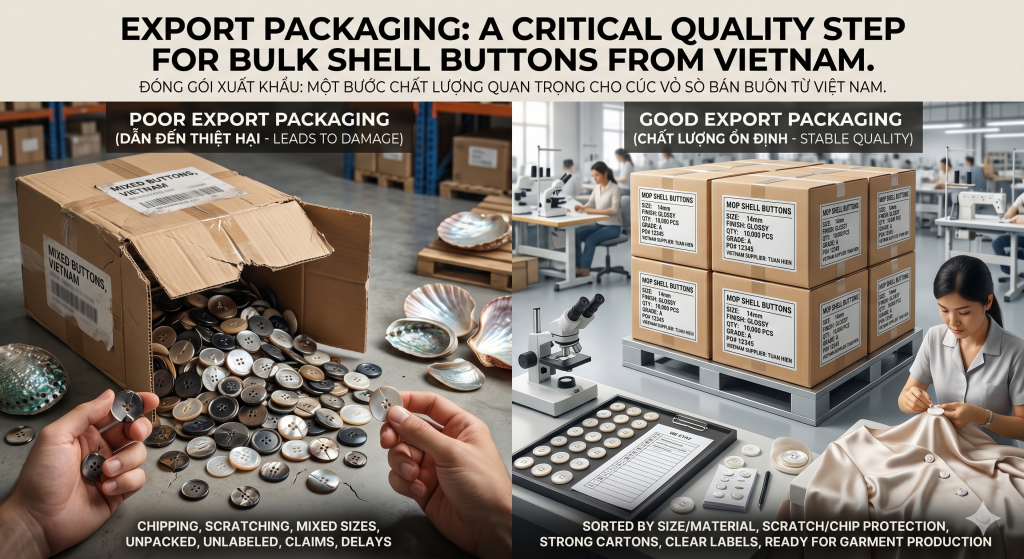
When buyers order shell buttons in bulk from Vietnam, they usually focus on material, size, thickness, finish, MOQ, and lead time. All of these are important. But there is one part that is often treated as a small detail, even though it can directly affect the final condition of the goods: export packaging.
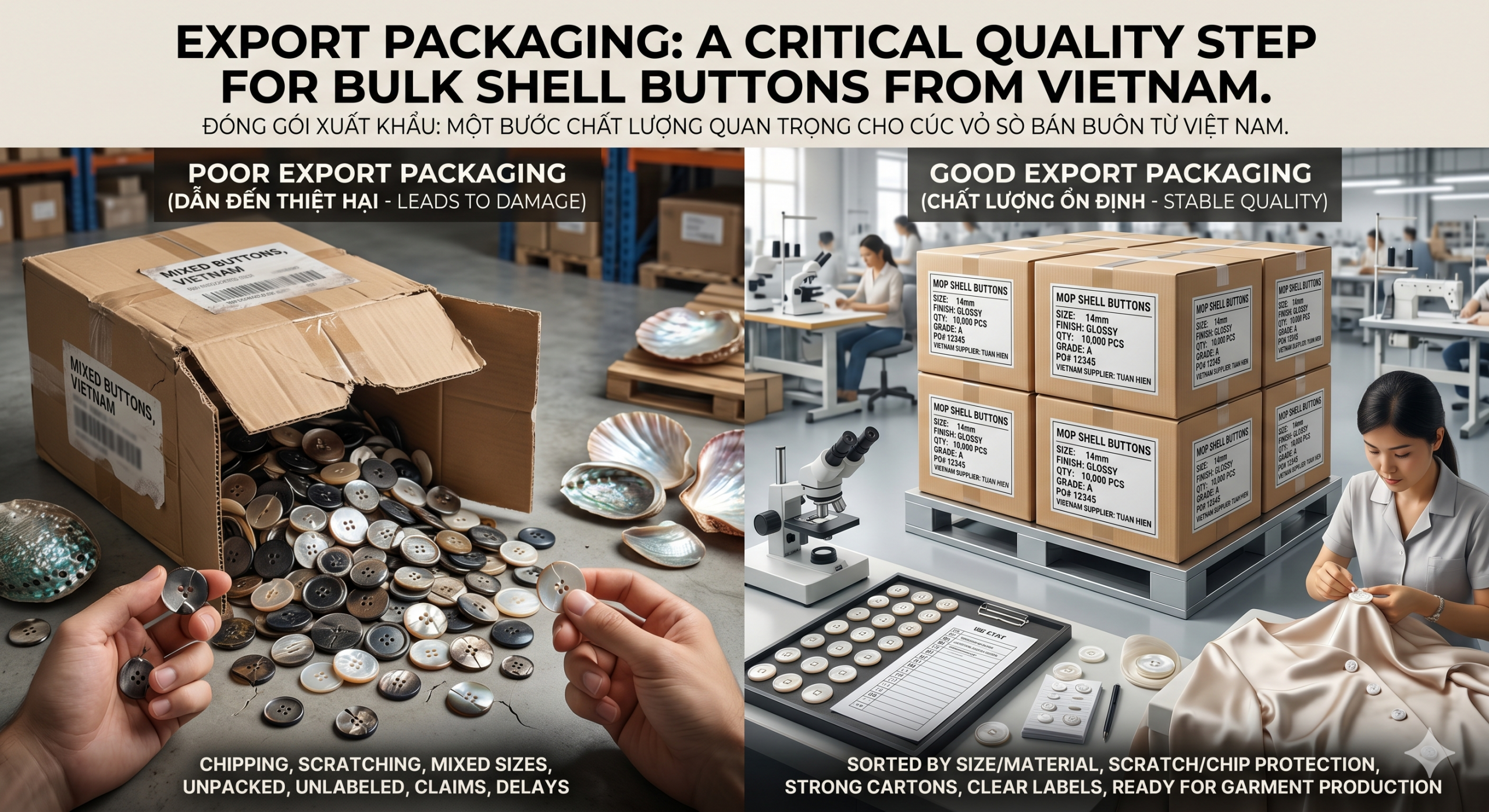
A shell button order may look perfect at the factory. The material is correct. The size is right. The finish looks good. QC has passed. But if the buttons are not packed properly, they can still arrive with chips, scratches, mixed sizes, mixed colors, or unclear labels.
For B2B orders, especially bulk shell button orders, packaging is not just the final step. It is part of product quality, part of QC, and part of a reliable export process.
Why Export Packaging Matters for Shell Buttons
Shell buttons are small, but that does not mean they are easy to ship. Because they are made from natural materials such as MOP, Trocas, Agoya, River shell, and Abalone, they need proper protection during packing, handling, and transportation.
If the packaging is weak, buttons may suffer from chipping, scratching, cracked edges, or surface damage. For buttons used on premium shirts, knitwear, luxury apparel, or export garments, even small defects can make the buttons unusable for production.
The important point is this: some problems do not happen during manufacturing. The goods may pass QC at the factory but get damaged during packing, loading, shipping, or warehousing. That is why packaging should be treated as the final protection layer before the order reaches the buyer.
Good Products at the Factory Can Still Arrive Damaged
This is a common issue in B2B sourcing. A supplier may send clear photos before shipment. The buttons look clean, consistent, and well-finished. But when the goods arrive, the buyer finds mixed sizes, chipped edges, scratched surfaces, or damaged cartons.
At that point, solving the problem takes time. The buyer needs to inspect the goods again, separate defects, take photos, send a claim, and wait for the supplier’s response. If the buttons are needed for garment production, this delay can affect the whole production schedule.
So the real question is not only:
Can the supplier make good buttons?
The better question is:
Can the supplier pack the buttons well enough so they arrive in stable condition?
That is why export packaging should be discussed from the beginning, ideally when the buyer sends the RFQ.
What Problems Should Packaging Prevent?
For shell buttons, the most common shipping-related issues are chipped edges, scratched surfaces, cracks, mixed sizes, mixed materials, mixed finishes, and unclear labeling.
Chipping can happen when buttons hit each other too strongly or are compressed during shipping. Scratches can happen when buttons are packed too loosely or without proper inner protection. Mixed sizes or mixed finishes usually happen when sorting and labeling are not managed carefully.
For B2B buyers, these issues are not only cosmetic. They can slow down warehouse receiving, inspection, and garment production. This is especially important when one order includes multiple sizes, materials, colors, or finishes.
Good Packaging Starts with Clear Sorting
A bulk shell button order usually includes more than one specification. A buyer may order 11mm, 12mm, 14mm, and 16mm buttons in the same shipment. One order may include both MOP and Trocas. It may also include matte, glossy, polished, or dyed finishes.
If the supplier does not sort the goods clearly, the buyer will lose time after receiving the shipment. Even worse, mixed sizes may lead the garment factory to use the wrong button on the wrong product.
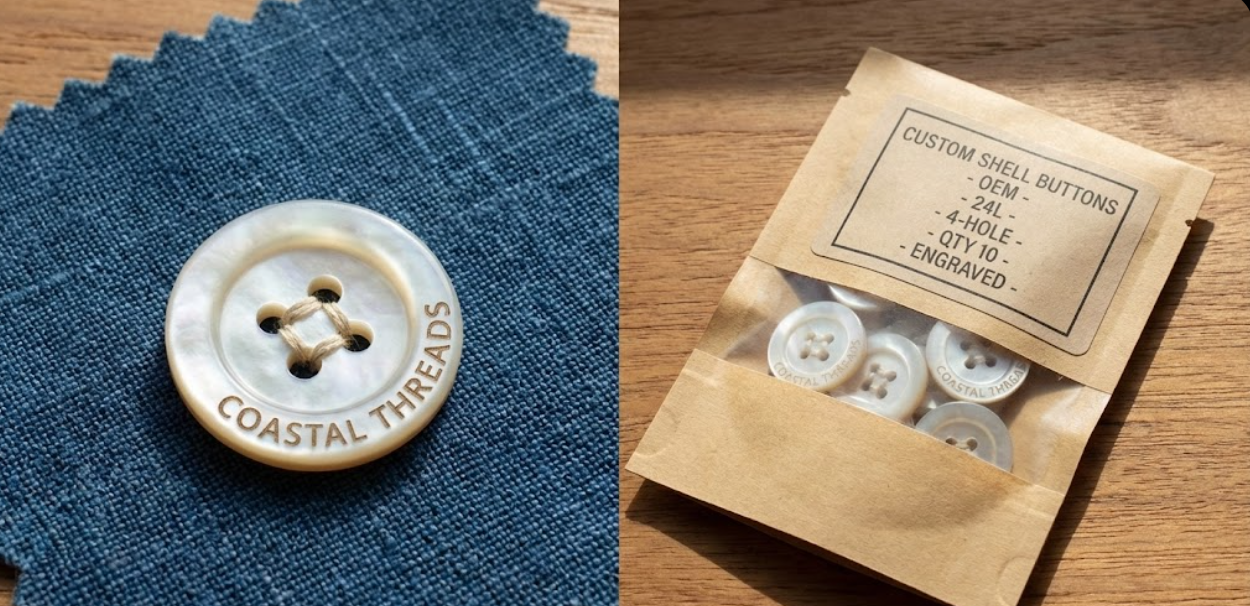
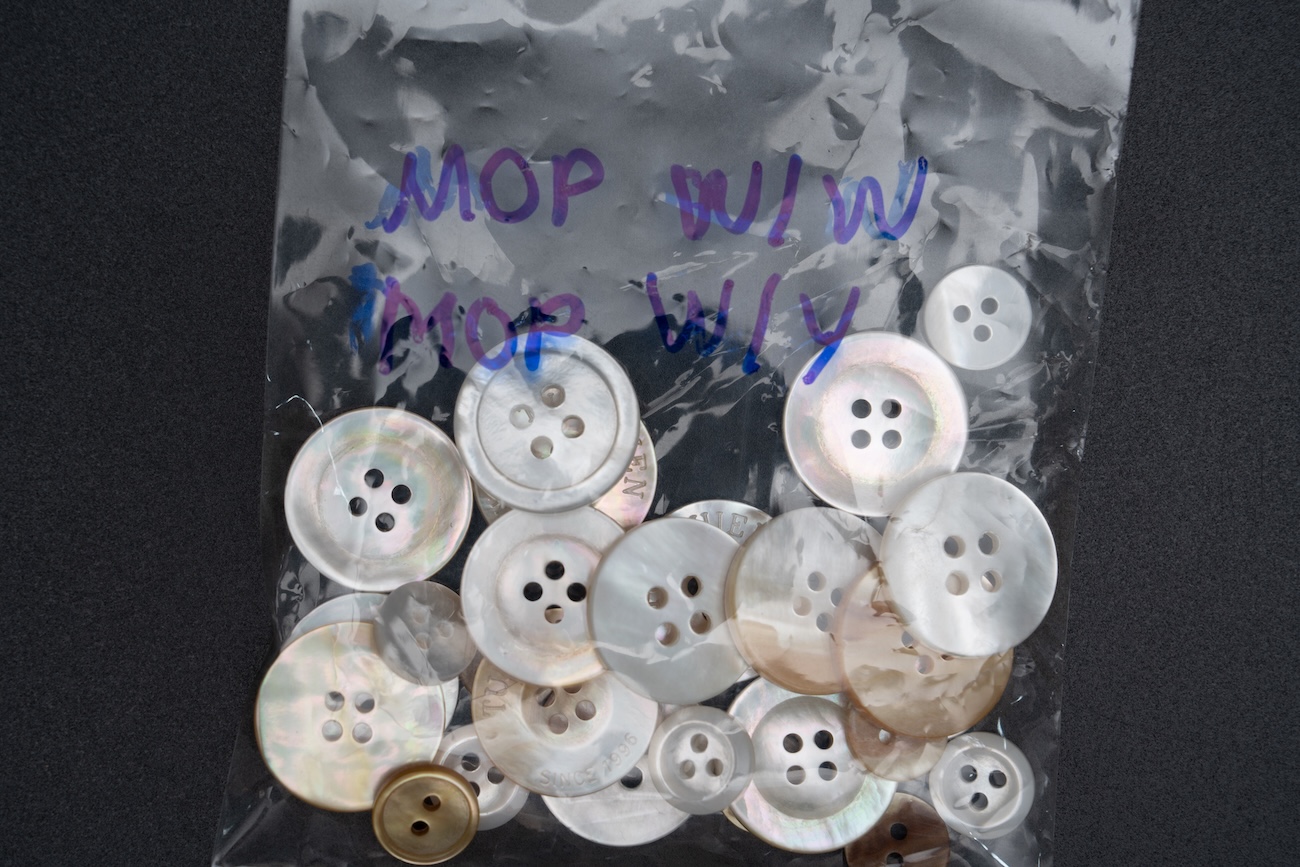
Good packaging starts with clear separation. Each size, material, finish, and item code should be packed separately and labeled clearly. Labels should show basic information such as material, size, quantity, finish, order number, or buyer item code if required.
This may sound simple, but it helps buyers inspect the goods faster and reduces mistakes during production.
Inner Packaging Should Prevent Scratches and Chips
For shell buttons, inner packaging is very important. If buttons are simply put into a large bag without proper protection, they may rub against each other during transportation.
Depending on the button type, quantity, and buyer’s requirements, suppliers may use smaller bags, inner layers, shock-absorbing material, or smaller quantity divisions per pack. The goal is to reduce friction and pressure on the buttons.
For premium orders, buyers should ask the supplier how many pieces are packed per bag, whether sizes are separated, whether surface protection is used, and whether the goods are checked again after packing.
This may seem like a small detail, but it is the detail that helps keep the button quality stable from the factory to the buyer’s warehouse.
Export Cartons Must Be Strong Enough
After inner packaging comes the outer carton. For export orders, the carton is not just a container. It must be strong enough for long-distance shipping, handling, stacking, and storage.
If the carton is weak, easily crushed, or not sealed properly, the goods inside can be affected. If the carton label is unclear, the buyer may also have difficulty checking multiple cartons at arrival.
A good export carton should have stable structure, reasonable weight, clear labeling, and correct carton information. If the order includes multiple item codes, each carton should clearly show what is inside so the buyer does not need to open every carton immediately.
For large orders, this saves a lot of time during receiving and inspection.
Does Packaging Affect Lead Time?
Yes, packaging can affect lead time, especially when the buyer requires special packing, private labels, detailed sorting, export cartons, or specific packaging standards.
Many buyers calculate lead time based only on production. But they forget to include sorting, final inspection, packaging, labeling, and export preparation. For small orders, this may not take too long. But for bulk orders, packaging can require a meaningful amount of time.
That is why buyers should ask clearly in the RFQ:
“Please confirm lead time for production, QC, packaging, and export preparation.”
This helps the supplier calculate the timeline more realistically. It also reduces the risk of a lead time that looks good at quotation stage but becomes difficult to meet in real production.
What Should Buyers Mention About Packaging in the RFQ?
If buyers want an accurate quotation and fewer surprises, packaging requirements should be included in the RFQ from the beginning.
Buyers should clarify whether the buttons should be packed in bags, boxes, or cartons; whether sizes must be separated; whether private labels are required; whether anti-scratch or anti-chip protection is needed; whether export cartons are required; and whether export documents are needed.
If the buyer or garment factory has a specific packing standard, it is best to send the file to the supplier early.
When packaging is discussed only after the price is confirmed, extra cost or extra lead time may appear later.
How Are Export Documents Related to Packaging?
For export orders, packaging and documents are often connected. The supplier does not only need to pack the goods properly. They also need to provide the information required for logistics and customs handling.
Depending on the shipping terms, buyers may need a packing list, invoice, carton details, gross weight, net weight, number of cartons, product description, and other export-related information.
If this information is unclear, the logistics process can slow down. That is why buyers should ask whether the supplier can support export documents and what information is needed before shipment.
This is especially important for orders shipped under FOB, CIF, DDP, or other specific Incoterms.
Good Packaging Reduces Claims and Saves Time
Some buyers see packaging only as a cost. But in B2B orders, good packaging can actually save money and time.
When buttons are packed correctly, buyers deal with fewer defects. Fewer defects mean fewer claims, fewer emails, less rechecking, and less disruption to production schedules.
For shell buttons, even a small defect rate can cause problems if the buyer needs to send the buttons directly into garment production. So good packaging does not only protect the buttons. It protects the buyer’s production plan.
How Tuan Hien Supports Export Packaging
For bulk shell button orders from Vietnam, Tuan Hien can help buyers clarify requirements for material, size, finish, quantity, QC, packaging, and export preparation.
If buyers need packing by size, material, finish, or item code, these requirements should be included in the RFQ so Tuan Hien can prepare properly. For export orders, clear packaging requirements from the beginning help make quotation, production, QC, and delivery more stable.
Tuan Hien can also support buyers in checking key packaging points such as scratch protection, chip prevention, sorting, labeling, cartons, and export-related information.
The goal is not only to deliver the correct quantity of buttons. The goal is to make sure the goods arrive in a condition that is easy to inspect, easy to store, and ready for production.
Conclusion
For bulk shell button orders, producing the right quality is only half of the order. The other half is packaging.
A shell button order can pass QC at the factory, but if export packaging is poor, the goods may still arrive chipped, scratched, mixed, or difficult to inspect. That is why packaging should be treated as part of QC and supply chain reliability.
Buyers should clarify packaging requirements from the RFQ stage: packing method, size separation, labeling, anti-scratch protection, anti-chip protection, export carton, destination, Incoterms, and required documents.
When these details are clear from the beginning, the supplier can quote more accurately, confirm a more realistic lead time, and reduce order risk.
Send your RFQ to Tuan Hien with material, size, finish, quantity, packaging requirements, and deadline to get practical export packaging support for your bulk shell button order from Vietnam.


