

When developing premium shirts, many buyers usually start with fabric, fit, collar shape, cuffs and stitching quality. That makes sense. But if the buttons are not chosen carefully, the shirt can still feel unfinished.
A button that is too thin, slightly off in color or poorly finished can make the whole shirt look less refined, even when the fabric is already good.
That is why choosing shell buttons for premium shirts should not be based only on how nice a button looks in a photo. Buyers need to consider material, size, thickness, surface finish, MOQ, lead time and production stability before moving into bulk orders.
Premium shirts need more refined buttons than regular shirts
Premium shirts are judged more closely than basic shirts. The fabric feels better. The fit is cleaner. The stitching is neater. Because of that, the buttons become more noticeable than many people expect.
A white shirt with thin plastic buttons may still be wearable. But when placed next to a shirt using natural shell buttons with a smooth surface, proper thickness and subtle natural shine, the difference is easy to feel. The shirt looks cleaner, more solid and more valuable.
For premium shirts, buttons do not need to look loud. The right button should make the shirt feel more balanced and complete. It should not take attention away from the fabric, but it should quietly support the overall quality of the garment.
This is why many shirt brands, tailoring houses, OEM factories and buying houses prefer premium shirt buttons instead of selecting buttons only by price or surface color.
Why shell buttons work well for premium shirts
Shell buttons have one clear advantage: natural beauty. Their shine is not flat like many plastic buttons. Shell buttons have depth, a soft shift in tone and a more natural look when viewed closely.
On premium shirts, especially white, light blue, beige, light grey or other neutral colors, shell buttons help the shirt look elegant without being too showy. This makes them suitable for dress shirts, business shirts, tailoring shirts and premium cotton shirts.
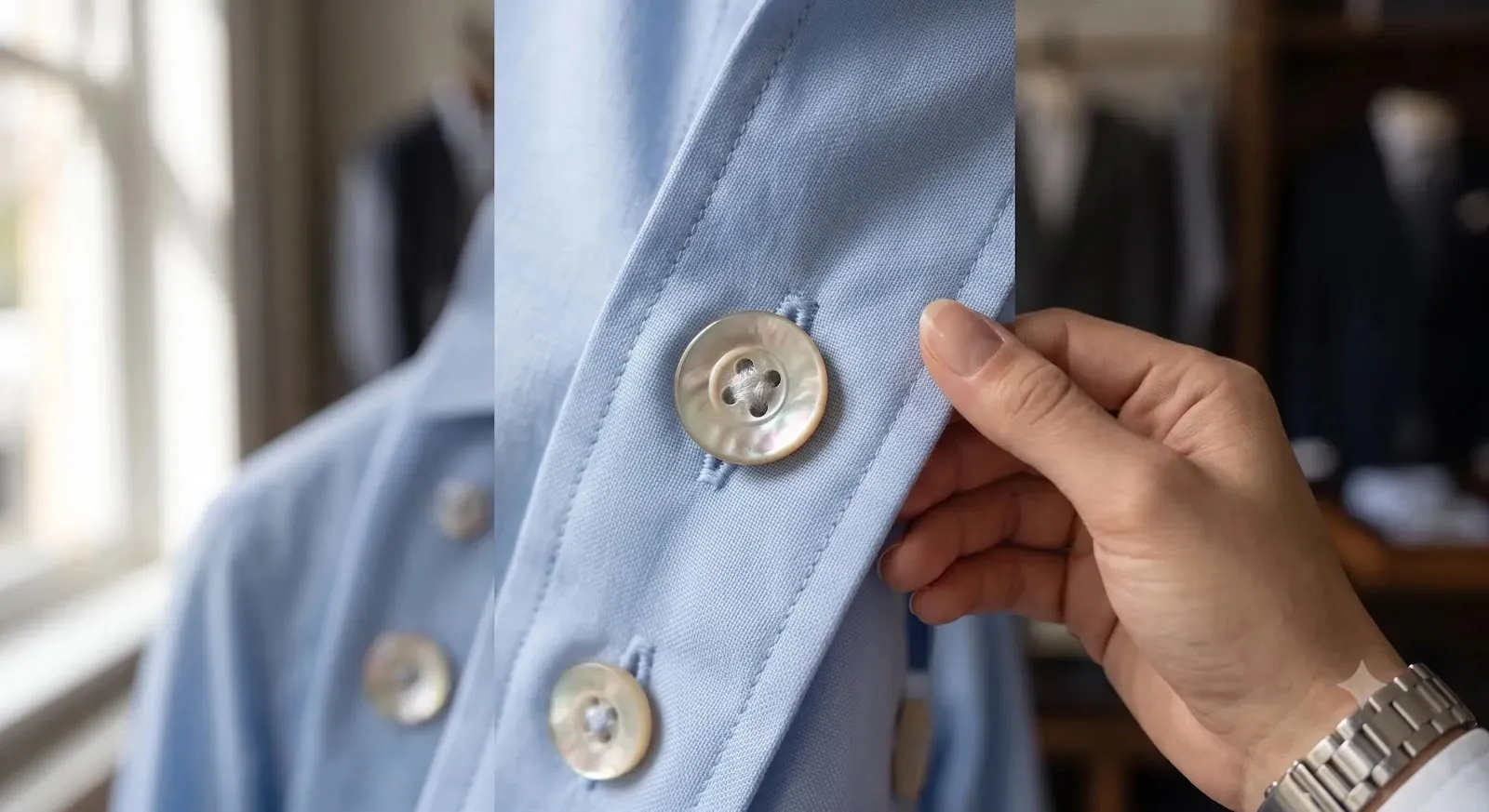
Another point buyers should consider is touch. Shell buttons often feel more solid in hand. When the wearer buttons or unbuttons the shirt, that small contact adds to the impression of quality.
For customers looking for shell buttons for B2B production, OEM projects or bulk shirt orders, Tuan Hien Buttons can be a practical supplier to consider.
Choosing the right material: MOP or Trocas?
When sourcing shell buttons, buyers may come across different materials such as MOP, Trocas, Agoya, River shell and Abalone. Each material has its own appearance and use case. For premium shirts, MOP and Trocas are usually the two most common options.
MOP buttons for shirts are suitable for premium lines
MOP, or Mother of Pearl, is a familiar choice for premium shirts. It has a natural pearlescent shine that feels soft and refined. When used on white or light-colored shirts, MOP gives the garment a more elegant look without making it feel excessive.
MOP buttons for shirts are often used for dress shirts, business shirts, luxury shirts and shirt lines that need a stronger premium feel. This material is suitable when a brand wants the shirt to feel well-made even in small details.
However, MOP is a natural material, so color, shine and surface patterns may vary slightly. If the order requires high consistency, buyers should discuss sorting standards, thickness, color tone and QC requirements with the supplier before approving production.
Trocas is practical when stability matters
Trocas is often suitable for orders that need stability, durability and repeat production. Its surface is natural and clean, while its structure is usually easier to control in bulk production.
If customers are producing casual premium shirts, high-quality uniform shirts or seasonal reorder programs, Trocas can be a practical option. It may not always give the same strong premium impression as selected MOP, but it offers better consistency for large-volume production.
In simple terms, MOP is suitable when the shirt needs a more refined premium look. Trocas is suitable when buyers need durability, stability and repeatable production quality across different batches.
Do not choose buttons only from catalogue photos
A button may look beautiful in a catalogue, but that does not always mean it will work well on the actual shirt. This is a common mistake in garment accessories sourcing.
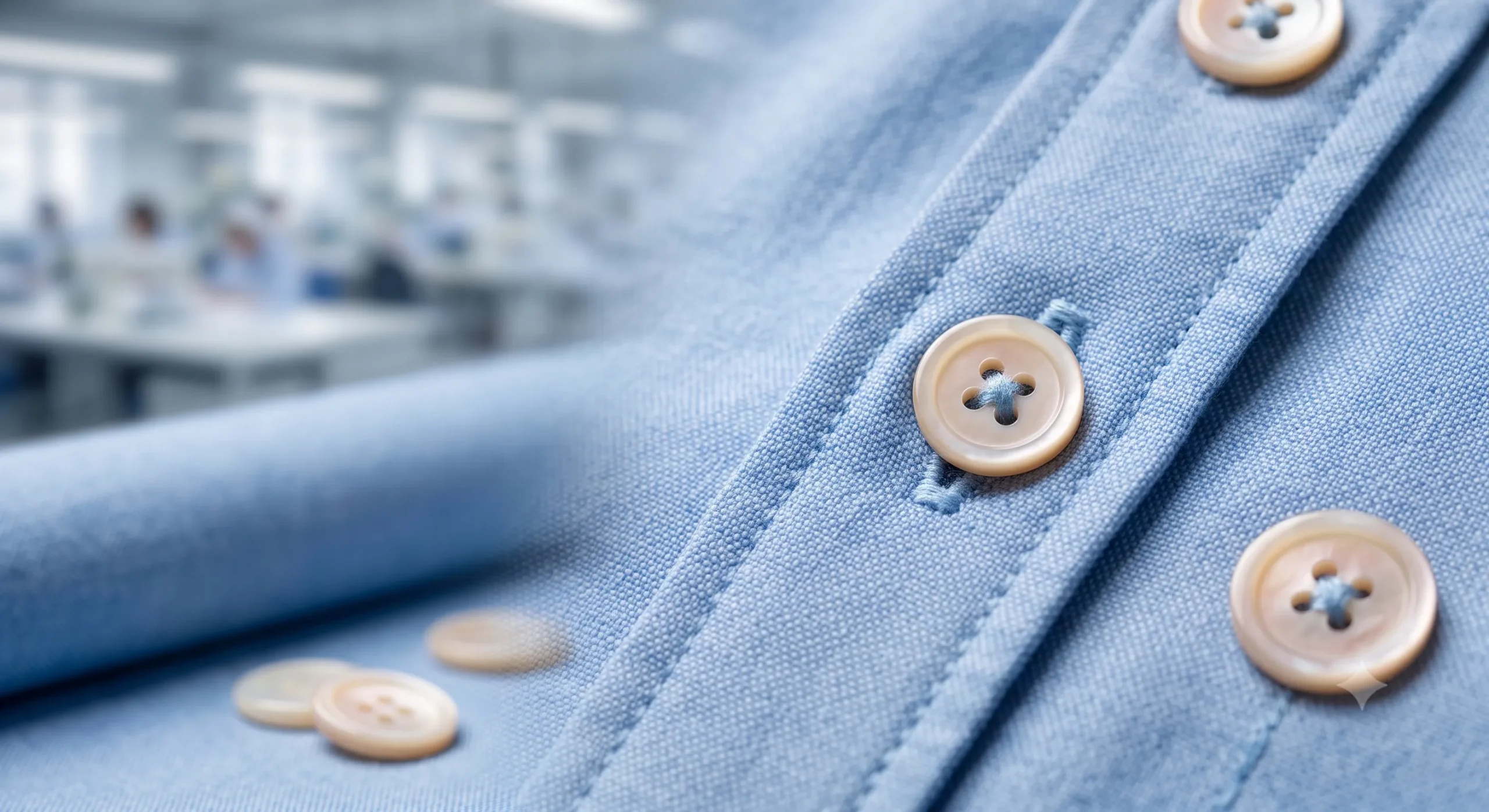
Catalogue photos are usually taken with good lighting, a clean background and a flattering angle. Once the button is placed on real fabric, the feeling can change. A button that looks white in the photo may look slightly off-tone on a cool white shirt. A button with strong shine may look attractive on its own, but too bright when used on a thin premium shirt.
For premium shirts, customers should test buttons on the actual fabric, in the actual shirt color and in the correct position. Front placket buttons, cuff buttons and collar buttons may require different visual balance.
The right button should not only look good in a sample box. It should look right on the finished shirt.
Button size should match the shirt structure
Size has a clear impact on how a shirt feels. A button that is too small can make the shirt look weak, especially on men’s shirts or thicker fabrics. A button that is too large can make the shirt lose its clean and elegant look.
For premium men’s shirts, buttons usually need to feel solid, easy to fasten and balanced with the placket. For women’s shirts or fashion shirts, size can be more flexible depending on the design. For cuff buttons, buyers should check separately because cuffs are used differently from the main front buttons.
When sending an RFQ, customers should clearly mention the button size in millimeters or ligne. If there is an old sample, it is better to send a real sample or clear photos so the supplier can understand the requirement more accurately.
The clearer the request, the easier it is to quote, sample and produce correctly.
Thickness affects the premium feel
Button thickness directly affects how the button feels when held, fastened and used. A button that is too thin may make the shirt feel light, but if it is too thin, it can also feel weak. With frequent use, thin buttons may not perform as well.
On the other hand, a button that is too thick may feel stronger, but if it does not match the fabric, it can make the shirt feel stiff or difficult to button.
For premium shirts, the user experience should feel smooth. The button should not feel too heavy, too hard or awkward to fasten.
Customers should mention the required thickness in the RFQ. If the brand has a specific tolerance, it should be stated clearly from the beginning. This small detail helps the supplier understand the product standard more accurately.
For shell buttons for premium shirts, consistency between buttons is also important. If one button is thicker, one is thinner or one has a noticeably different shine, the finished shirt can lose its refined appearance.
Finish: glossy, polished or matte?
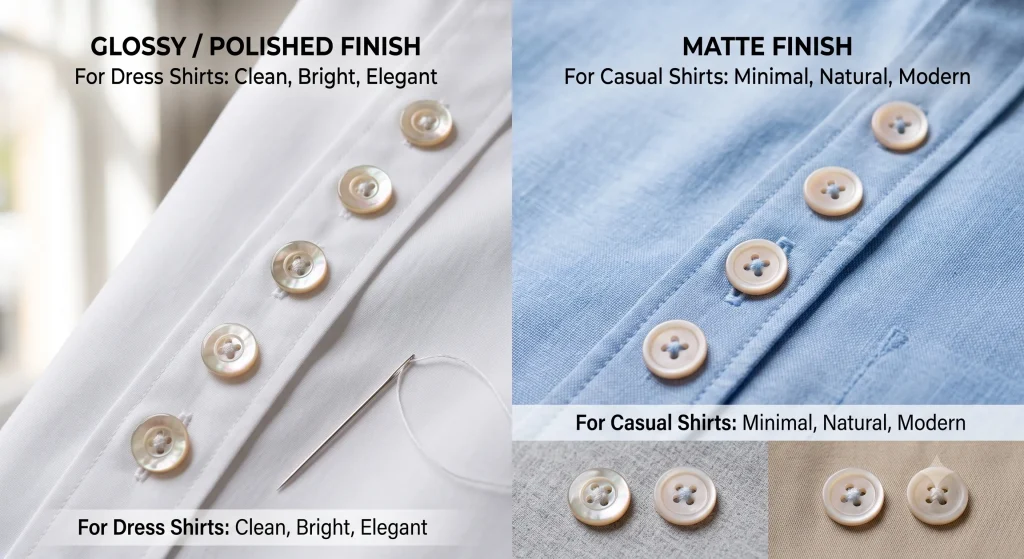
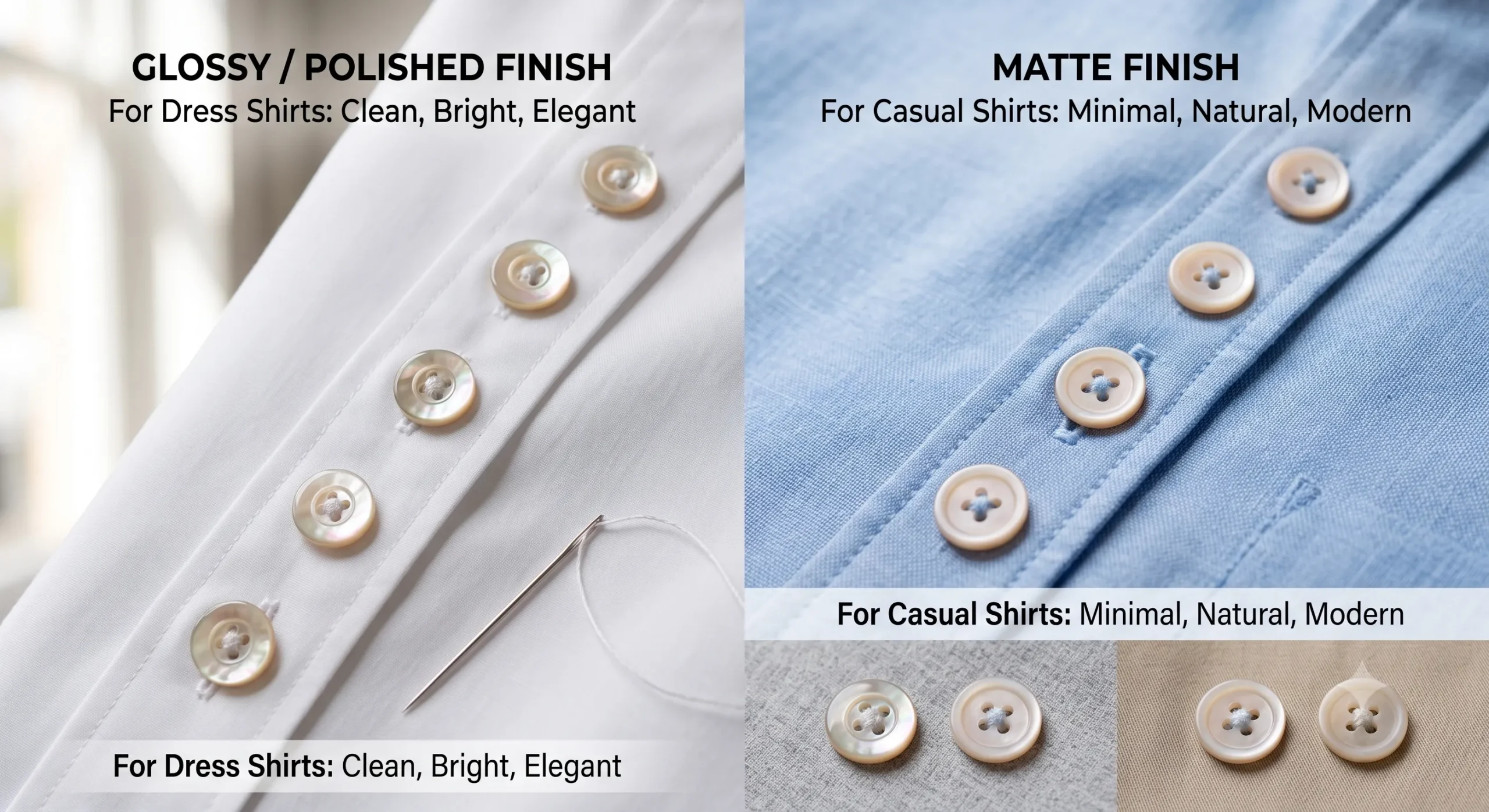
Finish affects the surface feel of the button. For premium shirts, glossy or polished finishes are often used when customers want a clean, bright and elegant look. This finish works well for dress shirts, premium cotton shirts and refined shirt designs.
Matte finish is more suitable for brands that prefer a minimal, natural or less shiny look. It does not catch light as strongly, but it can create a softer and more modern feeling.
There is no single finish that works for every product. The finish should match the fabric, shirt color, design concept and final customer segment.
A simple way to check is to place the button on the actual fabric under different lighting conditions. Natural light often helps buyers see the true color, shine and overall compatibility more clearly.
MOQ and lead time should be based on real requirements
When asking about MOQ and lead time, customers should avoid asking for one general number only. For shell buttons, MOQ and production time depend on material, size, thickness, finish, quantity and the level of customization.
A standard button style, common size, regular finish and no custom requirement will usually be easier to process. But if the order requires logo engraving, laser marking, custom size, custom thickness, dyed finish or special packaging, production will take more time because the supplier needs to check files, make samples and get approval before bulk production.
For premium shirts, customers should treat MOQ and lead time as part of the production plan. Button sourcing should not be left until the last minute, because if the sample is not approved, the entire shirt production timeline may be affected.
A clear RFQ should include material, size, thickness, finish, quantity, customization details, packaging, deadline and reference images. If an old sample is available, it is better to send the actual sample or clear photos.
QC should be specific, not just “good quality”
For premium shirts, QC needs to be specific. Customers should check size, thickness, hole position, button edge, surface quality, color, shine, cracks, chipped edges and consistency between batches.
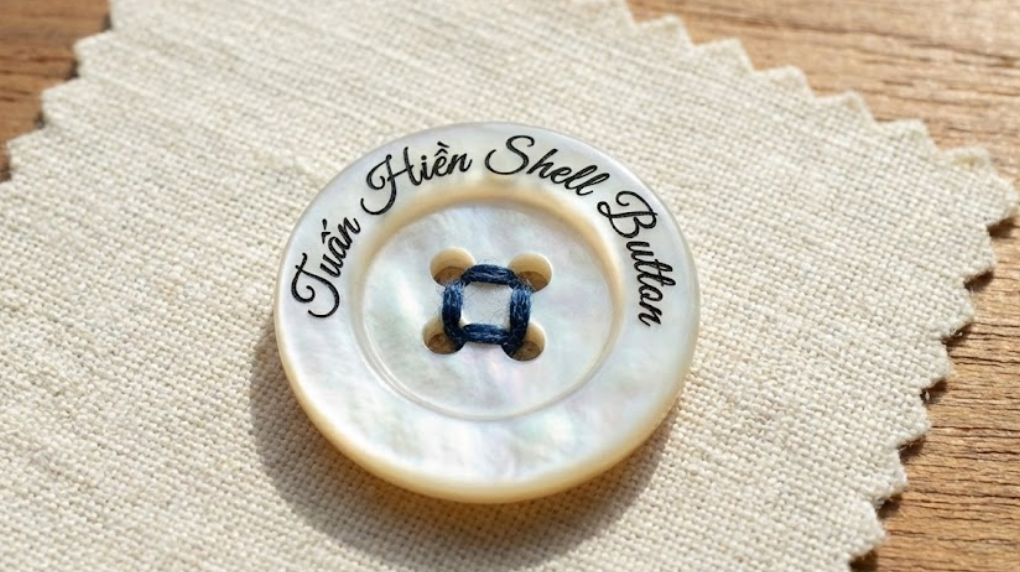
For MOP, buyers should pay extra attention to color tone, pearlescent shine and natural surface variation. For Trocas, buyers should check strength, edge finishing and hole drilling quality. If the order includes logo engraving or laser marking, sample approval becomes even more important. The logo should be clear, correctly positioned and should not weaken the button structure.
A golden sample should be approved carefully before bulk production. Once there is a standard sample, customers and suppliers can communicate more clearly if any issue appears during production.
This step helps reduce risk, especially for export orders or repeat orders across different seasons.
How Tuan Hien Buttons supports customers
For customers looking for shell buttons for premium shirts, the goal is not only to find a beautiful button. The more important part is choosing the right material, size, thickness, finish and QC standard for the actual shirt order.
Tuan Hien Buttons can support customers with material selection, size, thickness, finish, MOQ, lead time, sample approval, QC and packaging for shell button orders.
If customers need buttons for premium shirts, MOP can be a suitable option for a more refined look. If customers need stable bulk production or repeat orders, Trocas can be a more practical choice.
When the RFQ information is clear, quotation, sampling and production are easier to control.
Conclusion: The right button makes the shirt feel more complete
Choosing shell buttons for premium shirts should not start with the question, “Which sample looks the best?” A better question is: does this button fit the product, the customer segment and the production plan?
MOP is suitable for shirts that need a refined and premium feeling. Trocas is suitable when customers need stability, durability and repeatable production quality. Size, thickness and finish should be tested on the actual fabric. QC and golden samples should be confirmed before bulk production.
The right shell button does not make a premium shirt look complicated. It simply makes the shirt feel more complete, more solid and more reliable when the customer holds it in hand.
Customers who need advice on MOP buttons for shirts, premium shirt buttons or shell buttons for premium shirt orders can contact Tuan Hien Buttons at No.92 Truong Dang Que St., Ward Hanh Thong, Ho Chi Minh City, Vietnam, Tel: +84 283 9851258 for practical support based on their real order requirements.


