

For premium shirts, a custom logo button should not be developed by simply sending a logo file and waiting for production. It sounds simple, but in real production, there are many details to check: whether the logo is clear enough for engraving, whether the button should be made from MOP or Trocas, what size works best, whether the thickness is strong enough, whether the finish makes the logo too light, and whether the sample is ready for bulk production.
From the perspective of a Trim Product Developer, developing custom logo shell buttons is a process that needs clarity from the beginning. The better the sample stage is prepared, the fewer risks there will be when moving into bulk production.
Why brands should prepare carefully before making logo buttons
Custom logo buttons are often used when a brand wants to add a more personal identity to its product. For premium shirts, this detail matters even more. The logo does not need to be large or loud, but when the wearer looks closely, it should feel intentional and well-made.
The problem is that not every logo works well on a button. A logo that is too thin, too detailed, or has small letters placed too close together may look good in a design file, but when reduced to button size, it can lose clarity.
For example, a logo that looks clear on a neck label may not look clear when engraved on an 11mm or 12mm button. In real production, thin lines may become too light, curves may lose sharpness, or small letters may become difficult to read.
That is why, when developing shell buttons for premium shirts, brands should evaluate the logo at the actual button size, not only on a computer screen.
The first step: prepare the logo file properly
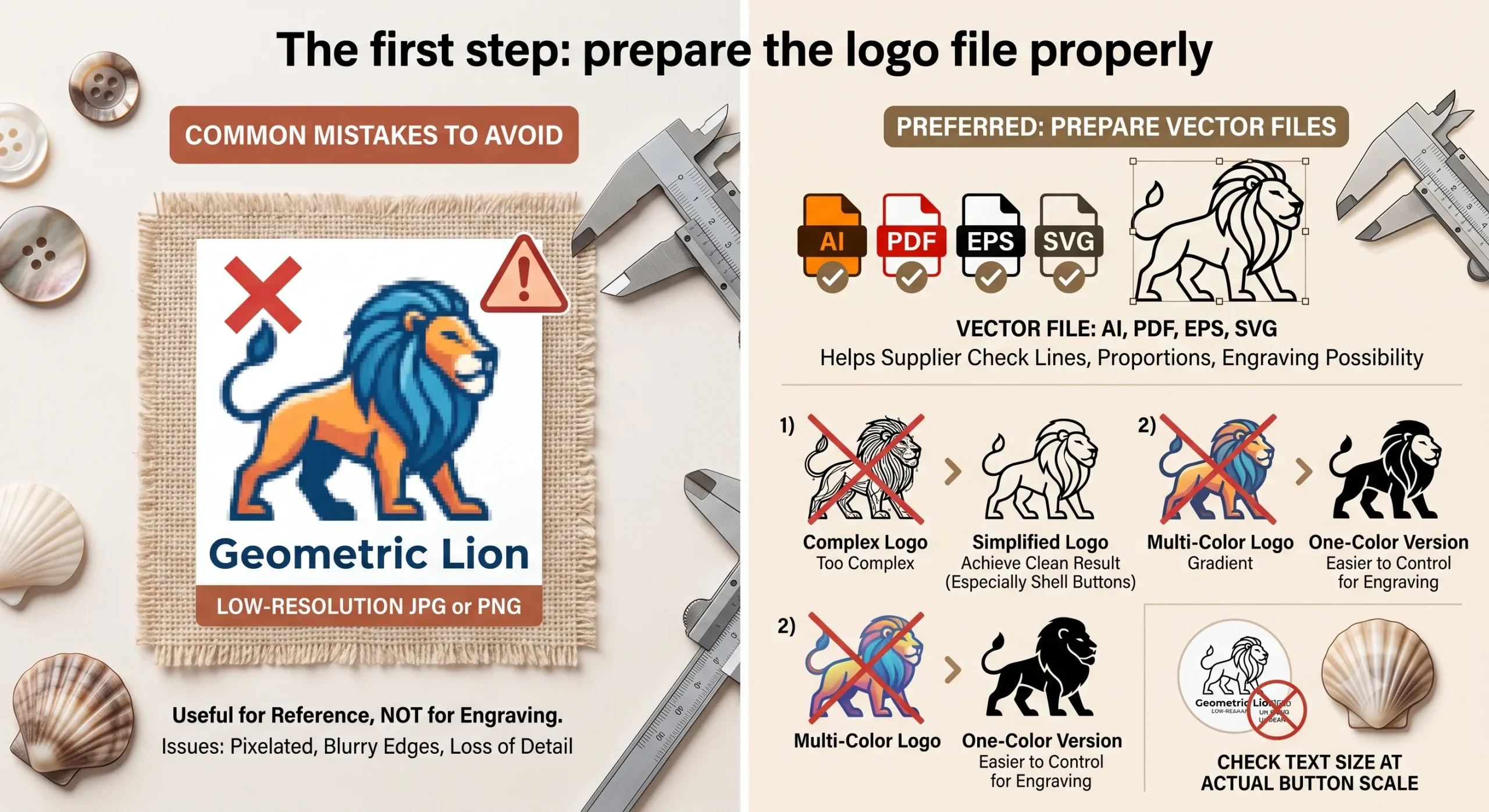
One common mistake is sending a low-resolution JPG or PNG logo. This may be useful for reference, but it is not always suitable for engraving.
For custom logo buttons, brands should prepare a vector file such as AI, PDF, EPS or SVG. A vector file helps the supplier check the lines, proportions and engraving possibility more accurately. If only an image file is available, the supplier can still review it, but the artwork may need to be adjusted before sampling.
The simpler the logo, the easier it is to achieve a clean result. This is especially true for shell buttons, because the button surface has natural shine and natural patterns. If the logo is too complex, some details may not appear as clearly as expected on the shell surface.
Brands should also prepare a one-color version of the logo. For engraving, a single-color logo is usually easier to control than a multi-color logo. If the logo includes text, the text size should be checked at actual button scale.
Choosing the material: MOP or Trocas for logo buttons?
Not every shell material gives the same result when engraved. For premium shirts, the two most common options are usually MOP and Trocas.
MOP buttons for shirts: suitable for premium lines
MOP buttons for shirts are often selected for dress shirts, luxury shirts, business shirts and premium cotton shirts. MOP has a natural pearlescent shine that feels soft and refined. When a logo is engraved on MOP, the final result can look elegant, especially when the logo is simple and the lines are clear.
However, MOP is a natural material, so the surface, tone and shine may vary slightly. If the logo needs to be highly visible, the supplier should carefully check engraving position, engraving depth and finish. Some MOP buttons with stronger shine may make the engraved logo appear lighter from certain angles.
For brands that want a premium but subtle feeling, MOP is a material worth considering.
Trocas: more stable for bulk production
Trocas is often suitable when a brand needs stability in larger-volume orders. Its surface is natural and clean, and it is often easier to control in bulk production. If a brand needs seasonal reorders or the same standard across multiple batches, Trocas can be a practical choice.
For logo engraving, Trocas can deliver stable results when size, thickness and finish are clearly defined. It is suitable for casual premium shirts, high-quality uniform shirts or product lines that require durability and repeatable production.
In simple terms, MOP creates a stronger premium feeling. Trocas is more practical when the brand needs consistency in bulk production.
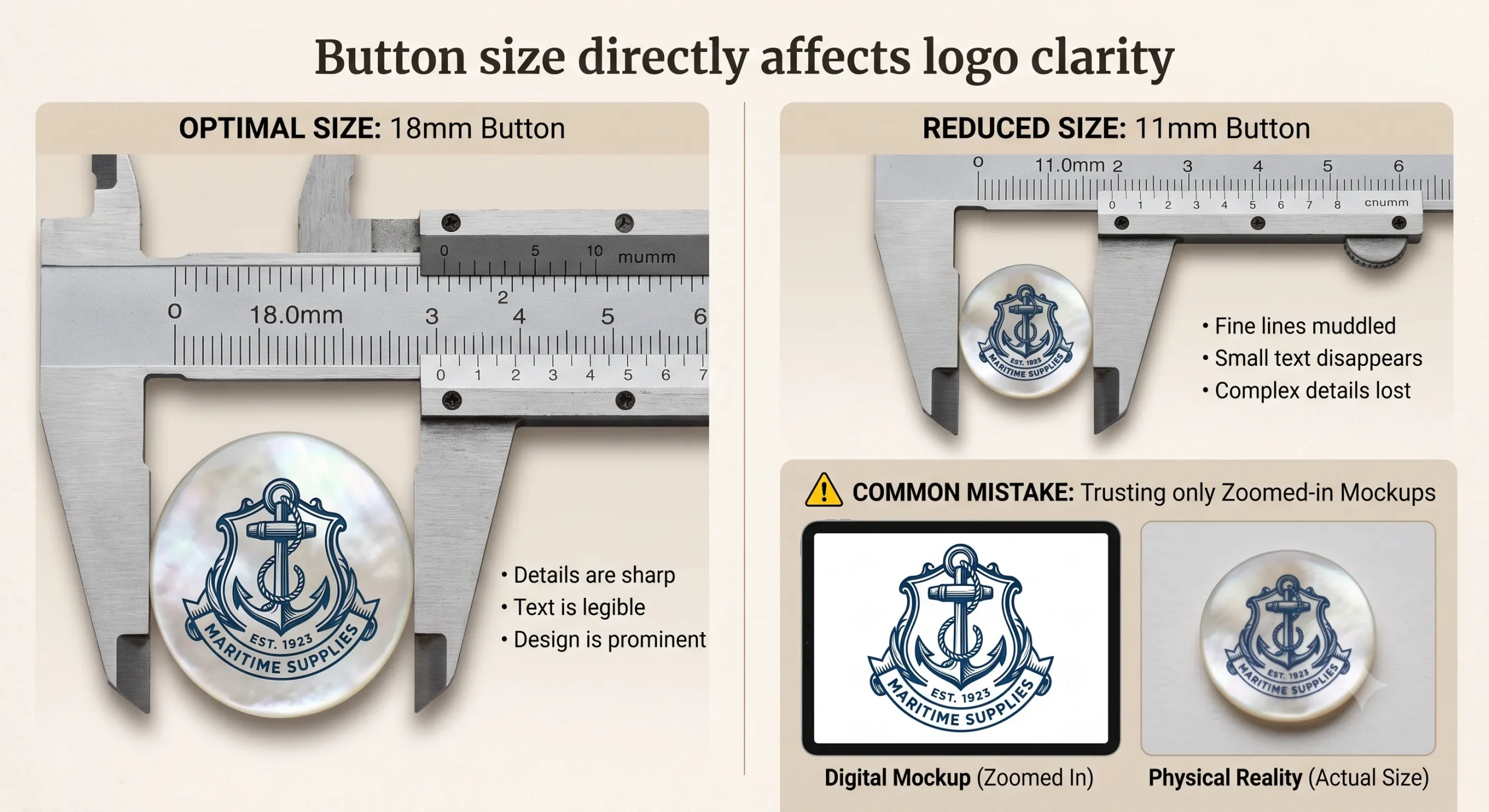
Button size directly affects logo clarity
When developing custom logo shell buttons, size is not only about appearance. Size also determines whether the logo can be seen clearly.
A logo may look good on an 18mm button, but when reduced to 11mm, many details may disappear. Since shirt buttons are usually not very large, brands need to be realistic about logo clarity.
If the logo includes small text, complex symbols or many fine lines, it should be tested on the actual button size. Do not approve only a zoomed-in mockup. A large mockup can make everything look cleaner than it will be in real production.
For premium shirt buttons, the button needs to match the shirt structure and still provide enough space for the logo. If the button is too small, the logo may not be clear. If the button is too large, the shirt may lose its clean and elegant look.
Thickness: do not let the button look good but feel weak
Thickness is something buyers and brands should check early. A logo button needs to be strong enough for regular use, especially on shirts that will be worn often.
If the button is too thin, the logo may still be engraved, but the button may not feel strong enough in hand or during fastening. For premium shirts, wearers often judge quality through small touchpoints such as fastening the front buttons, opening the cuffs or touching the collar button.
On the other hand, a button that is too thick may make the shirt feel stiff or difficult to fasten if it does not match the fabric. Thickness should balance strength, usability and shirt design.
In the RFQ, brands should mention the desired thickness clearly. If they are not sure, they can send a shirt sample, an old button sample or reference photos so the supplier can suggest a more suitable specification.
Choose the finish before approving the logo
Finish affects how the logo appears on the button. Some finishes make the logo more visible, while others create a softer and more subtle look.
Glossy or polished finish usually makes the button look brighter, cleaner and more elegant. However, if the surface is too shiny, the engraved logo may look different under different lighting conditions.
Matte finish often gives a softer, more natural and less reflective appearance. For brands with a minimal style, matte finish can make the logo look more refined and less obvious.
The important point is that logo approval and finish approval should not be separated. These two elements must be reviewed together on the actual sample. A logo may look clear on one finish but less effective on another.
First sample: do not rush into bulk production
After the logo, material, size, thickness and finish are confirmed, the next step is sampling. This is a very important stage because the first sample shows the real result, not just the idea on a file.
When receiving the sample, the brand should check whether the logo is clear, whether the position is correct, whether the engraving depth is suitable, whether the button surface is clean, whether the edge is smooth and whether the color works with the shirt fabric.
A small problem in the sample can become a big problem when producing thousands or tens of thousands of buttons. If the sample is not good enough, it should be adjusted at this stage. Do not assume that bulk production will automatically look better.
For custom logo shell buttons, sample approval is the key control point in the whole process.
Golden sample: the standard for bulk production
Once the sample is approved, the brand should keep a golden sample. This becomes the reference standard for bulk production.
A golden sample helps the supplier control production. It also helps the brand evaluate the final shipment. If there are differences in logo clarity, color, shine, thickness or surface quality, both sides can compare the goods with the approved sample instead of judging by feeling.
For repeat orders, the golden sample is even more important. If the brand wants to maintain the same button feel across different seasons, the approved sample helps reduce variation between batches.
This is a practical method that brands, buying houses and OEM factories should use when developing custom trims.
MOQ and lead time change depending on the level of customization
Custom logo shell buttons usually require a different MOQ and lead time compared with standard buttons. If the brand selects an existing style, common size and regular finish, the process is usually faster. But when logo engraving, laser marking, custom thickness or special packaging is required, the supplier needs more time to check the file, make samples, adjust samples and get approval.
Brands should calculate lead time from the sample development stage, not only from the bulk order date. If the shirt production deadline is already close, developing logo buttons may create pressure for the buyer, factory and supplier.
A clear RFQ will make the process faster. Brands should send the desired material, size, thickness, finish, quantity, logo file, logo position, deadline and packaging requirements if any.
If the brand is not sure whether to choose MOP or Trocas, it can share the product purpose: premium shirt, casual premium shirt, uniform shirt or luxury shirt. From there, the supplier can give a more practical recommendation.
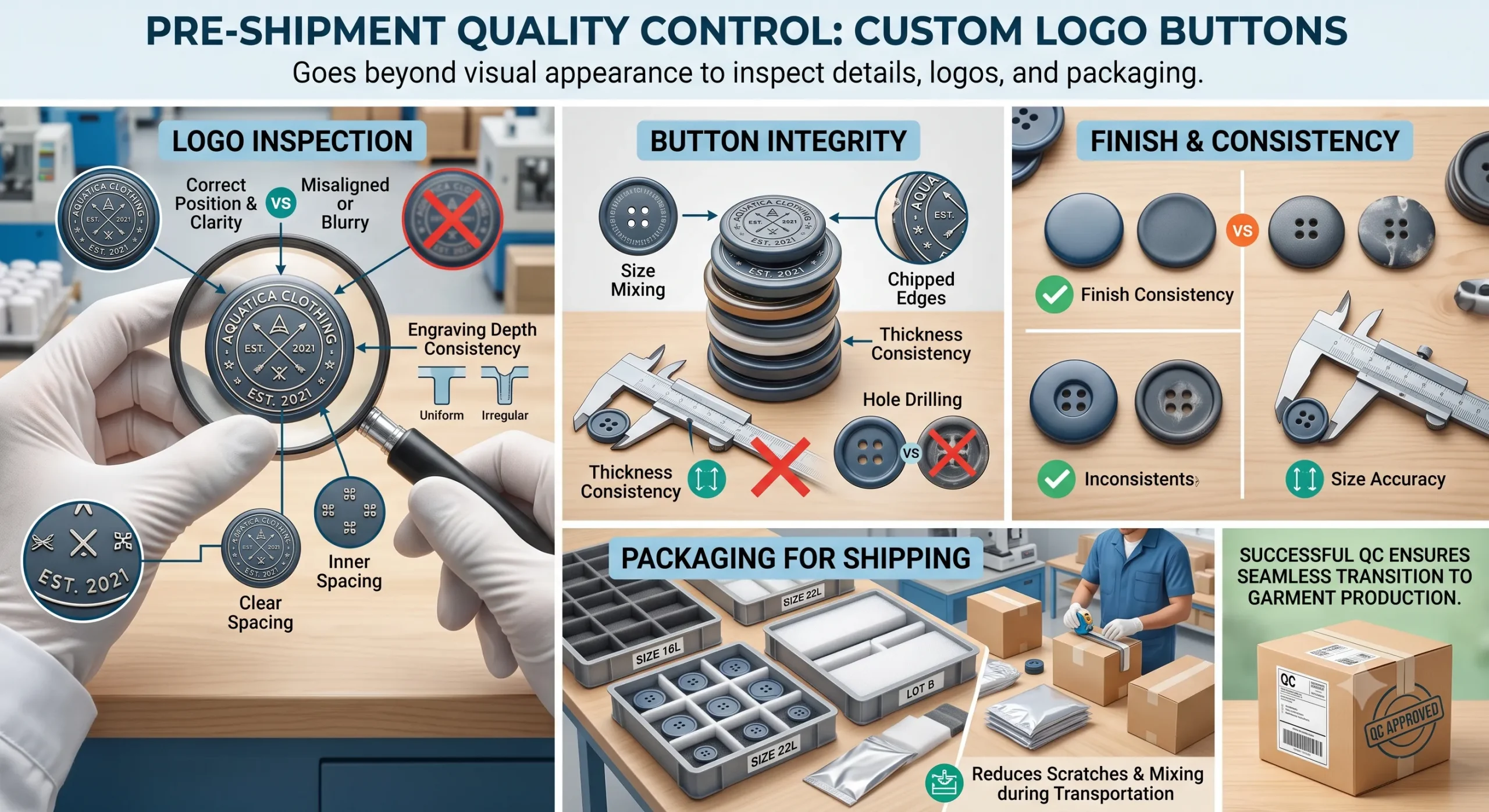
What should QC check before shipment?
For logo buttons, QC should not only check whether the button looks good. The logo also needs to be inspected carefully.
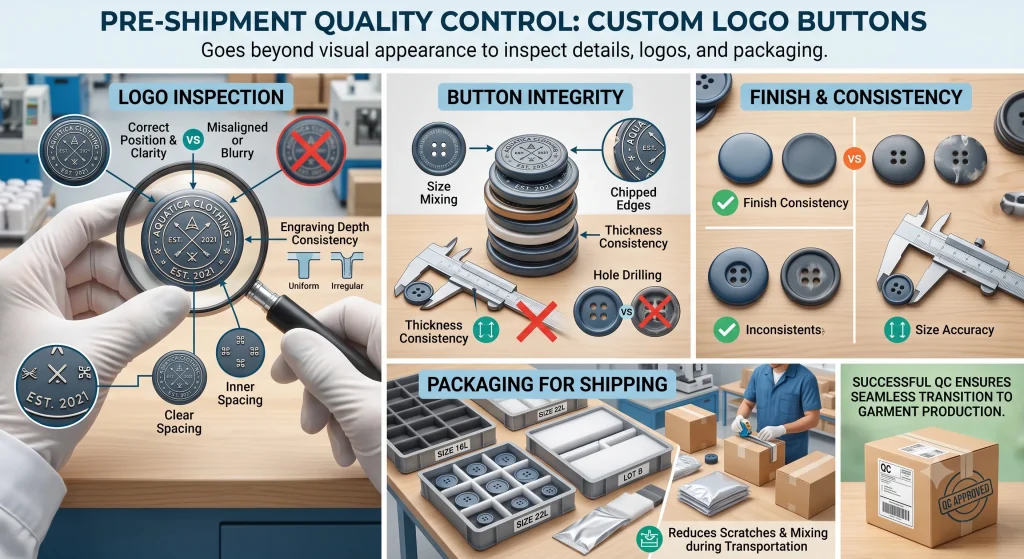
Important points include logo position, logo clarity, engraving depth consistency, chipped edges, hole drilling, thickness consistency, finish consistency and size mixing. If the logo includes text, the letters should be checked to make sure they are not blurred or lost. If the logo is a small symbol, curves, sharp corners and inner spacing should also be reviewed.
Packaging should also be clear. Custom logo buttons should be packed in a way that reduces scratches, chipped edges and size mixing during transportation.
A custom order that looks good at the sample stage but is weak in QC can still create problems when the buttons move into garment production.
How TUAN HIEN supports brands with custom logo shell buttons
For brands looking for shell buttons for premium shirts, developing a button from logo to bulk production requires clear coordination between the brand, factory and supplier.
TUAN HIEN can support customers with material selection, size, thickness, finish, logo file checking, sampling, sample approval, QC standards and preparation for bulk production.
If the brand needs buttons for premium shirts, MOP can be suitable when a more refined look is required. If the order needs stability for large-volume production or repeat orders, Trocas can be a more practical option.
The important thing is to prepare clear information from the beginning. When the requirement is clear, quotation, sampling and production are easier to control.
Conclusion: A good logo button starts with a clear development process
A beautiful engraved button does not begin with the engraving machine. It begins with a suitable logo file, the right material, a button size that fits the shirt, a thickness that feels strong enough, a finish that works with the logo and a sample that is carefully approved.
For premium shirts, custom logo shell buttons should be developed carefully before moving into bulk production. Do not only check the logo on a screen. Test it on a real button, place it on real fabric and review it under real lighting.
When every detail is clear, bulk production becomes less risky. The brand can also maintain better consistency for future orders.
Customers who need advice on MOP buttons for shirts, premium shirt buttons or custom logo shell buttons for premium shirts can contact TUAN HIEN via HOTLINE: +84 283 9851258 for support based on real order requirements.


