


For dress shirts, a premium look does not come from one single detail. It comes from the fabric, the fit, the stitching, the collar, the cuff and also the buttons on the front placket. Among these details, buttons are small, but they are easy to notice when customers hold the shirt in their hands.
That is why many premium brands choose MOP buttons for dress shirts. MOP has a natural pearlescent shine, a refined surface and a more genuine feel compared with many standard buttons. But choosing MOP also requires clear standards. If the size, thickness, finish or QC is not controlled properly, even a beautiful button can make the final shirt feel inconsistent.
Why dress shirts need better buttons
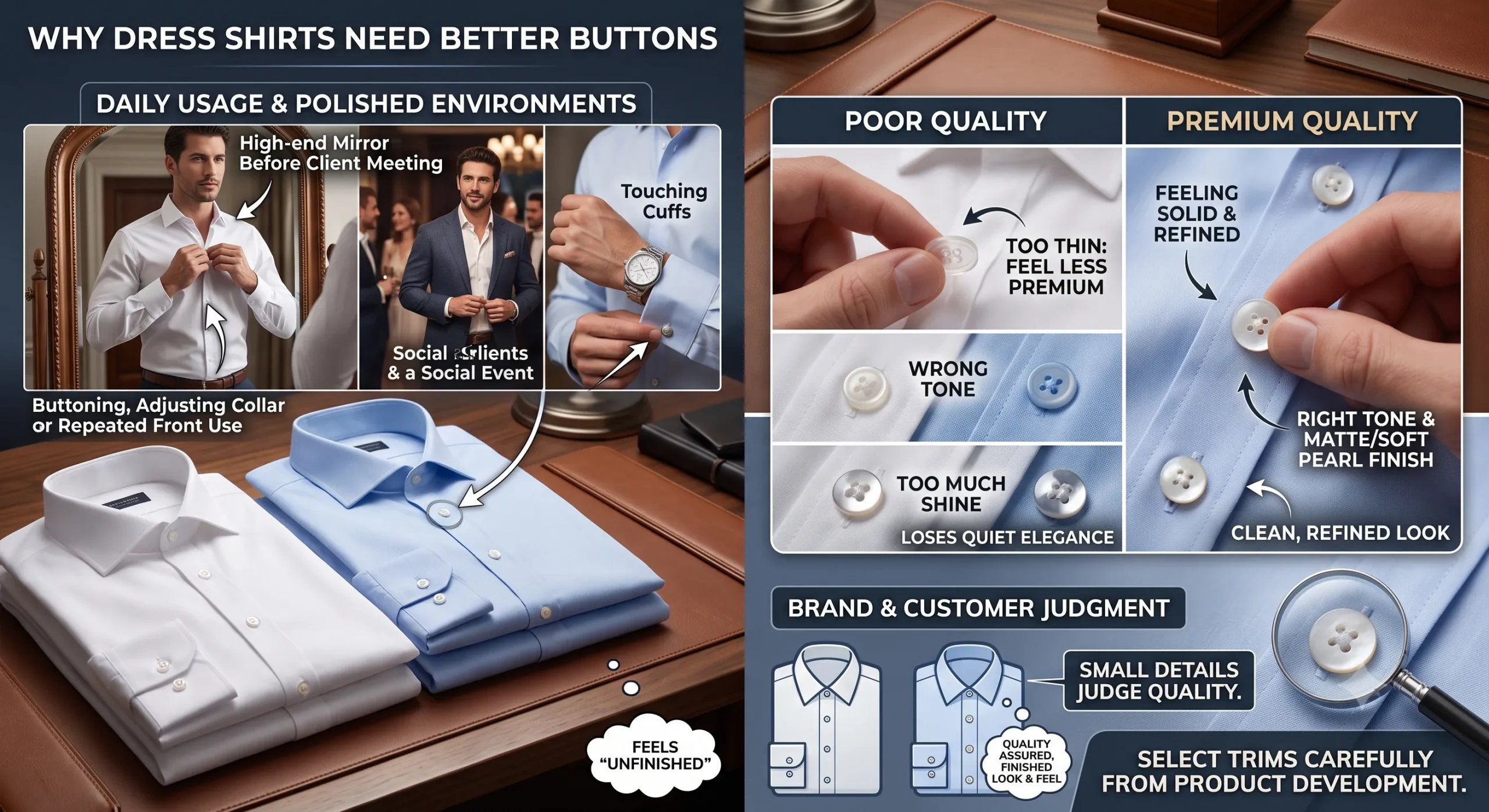
Dress shirts are often worn in settings that require a clean and polished appearance: work, client meetings, events, business travel, or with suits and blazers. The wearer does not only look at the shirt from a distance. They button it, adjust the collar, touch the cuffs and use the front buttons many times during the day.
Because of that, dress shirt buttons need to feel solid, clean and refined. A button that is too thin can make the shirt feel less premium. A button with the wrong tone can look off on white or light blue fabric. A button with too much shine can sometimes make the shirt lose its quiet elegance.
For premium brands, customers often judge quality through very small details. They may not say, “This button is not good enough,” but they can still feel that the shirt is not fully finished. This is why trims should be selected carefully from the product development stage.
What is MOP and why does it work well for dress shirts?
MOP stands for Mother of Pearl. It is also commonly known as pearl shell or nacre button material. The most noticeable feature of MOP is its natural shine. It is not flat like plastic, and it is not overly sharp like some artificial surfaces. When viewed closely, MOP has depth, natural texture and a soft shift of light depending on the angle.
For dress shirts, especially white, light blue, beige, light grey or neutral-colored shirts, MOP helps the garment look cleaner and more elegant. It does not make the shirt look flashy. It simply makes the shirt feel more carefully finished.
This is why many brands use Mother of Pearl buttons for shirts in premium shirts, business shirts, tailoring shirts and luxury cotton shirts. For these product lines, the button is not just a fastening detail. It is part of the product feeling.
How MOP makes dress shirts look more premium
A premium dress shirt usually aims for a clean and refined look. MOP fits this direction because it has a natural beauty that does not feel artificial. When placed on premium cotton, poplin, twill or fine oxford fabric, MOP usually feels more balanced than ordinary plastic buttons.
There is also a practical point: premium customers often look at products more closely. They touch the fabric, check the stitching, look at the cuffs, examine the collar and notice the buttons. If the button has a natural shine, smooth edges, clean holes and proper thickness, the shirt feels more valuable.
MOP also helps brands keep a subtle premium image. It does not need a large logo. It does not need a loud color. With the right tone, finish and thickness, it can already make the shirt feel different.
When should brands choose MOP instead of standard buttons?
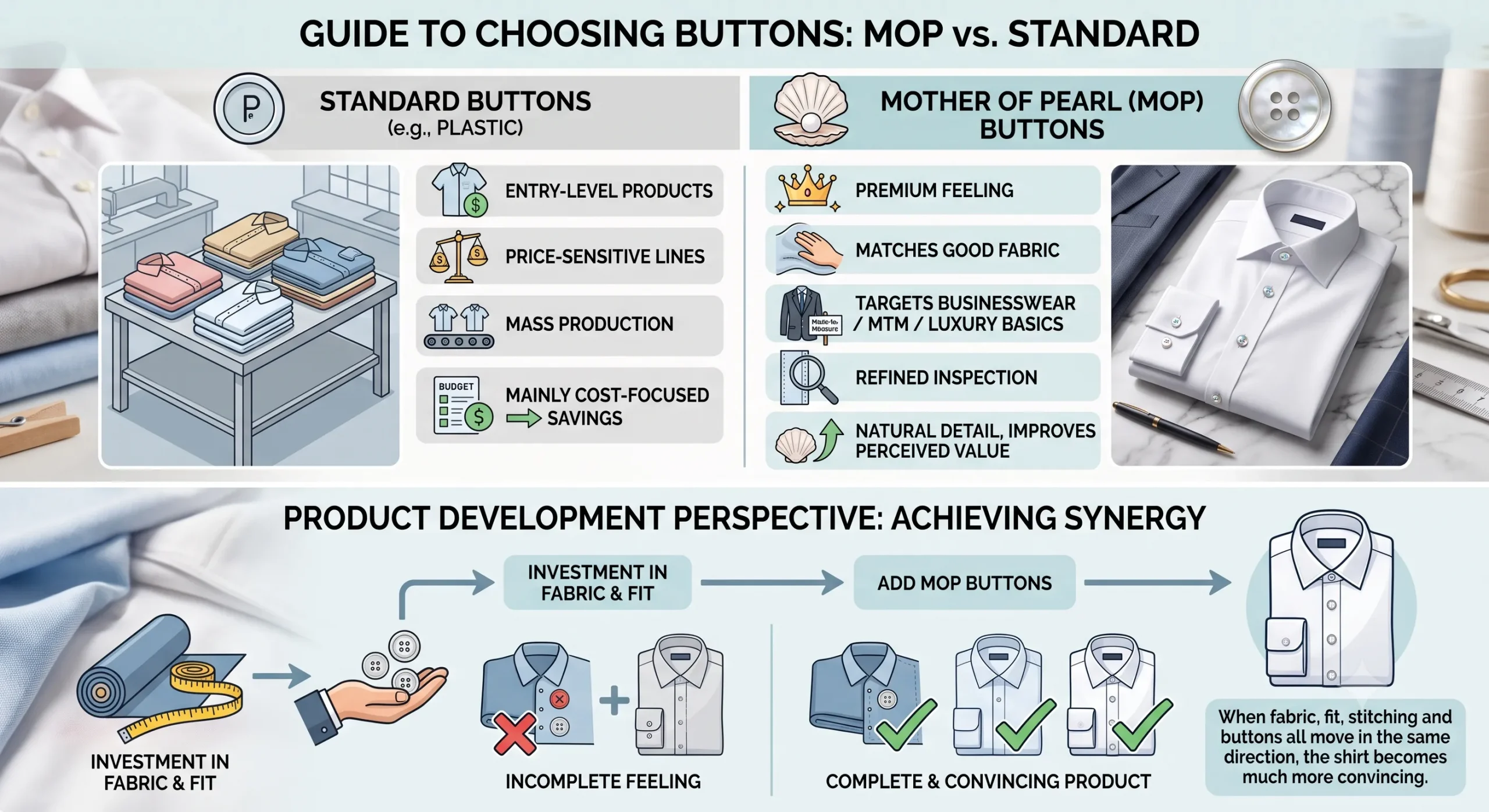
Not every shirt line needs MOP. If the product is entry-level, price-sensitive, produced in very large quantities and focused mainly on cost, plastic buttons or other standard buttons may be more suitable.
But for premium dress shirts, MOP is worth considering in these cases:
The brand wants to create a more premium feeling.
The shirt uses good fabric and needs trims that match the same level.
The product targets businesswear, made-to-measure, premium officewear or luxury basics.
The brand wants the button placket to look more refined when customers inspect the shirt closely.
The product needs a natural detail that is not too loud but still improves perceived value.
From a product development perspective, MOP works best when the shirt has already been invested in properly through fabric and fit. If the fabric is good but the buttons feel weak, the whole product can feel less complete. When fabric, fit, stitching and buttons all move in the same direction, the shirt becomes much more convincing.
MOP button size should match the shirt structure
Size is something buyers should confirm early. For dress shirts, buttons usually need to maintain an elegant look. If the button is too large, the shirt can look less clean. If the button is too small, the placket may feel weak, especially on men’s shirts or slightly thicker fabrics.
When choosing size, brands should look at the full garment: placket width, fabric thickness, collar style, cuff design and product positioning. A button that works for a casual shirt may not be right for a dress shirt worn with a suit.
The best way is to place the button on the actual fabric and view it at a real distance. Do not judge only from a sample box. A button can look good on its own but feel slightly off when placed on white fabric. A size that looks fine on screen may look too small on the finished shirt.
For MOP buttons for dress shirts, the right size is usually the one that makes the shirt look balanced, without making the wearer pay too much attention to the button itself.
Thickness directly affects the premium feel
MOP can look beautiful, but if it is too thin, the shirt can still lose its premium feeling. Thickness is something the wearer can feel clearly when fastening or unfastening the shirt.
A button that is too thin can feel light and weak. For dress shirts, especially men’s shirts or shirts made with good cotton fabric, the button needs a certain level of solidity. On the other hand, a button that is too thick can make the shirt difficult to fasten or visually too heavy.
The right point is balance. The button should feel strong enough in use, but it still needs to match the fabric thickness and sewing construction.
When sending an RFQ, brands should mention the desired thickness clearly. If there is no fixed standard yet, they can send a shirt sample or an old button sample so the supplier can suggest a suitable specification. Thickness should not be left to guesswork, because each brand has its own product standard.
Finish: choosing the right shine for the brand
MOP buttons can be produced with different finishes. For dress shirts, polished or glossy finishes are often chosen when the brand wants a clean, bright and elegant look. This finish works well for office shirts, white dress shirts, premium cotton shirts and tailoring lines.
Matte finish is more suitable for brands that prefer a softer and less reflective appearance. It can create a natural and modern feeling, especially for minimalist shirt collections.
There is no finish that works for every shirt. A classic menswear brand may prefer polished MOP. A modern minimalist brand may prefer matte MOP. The important thing is to place the button on the actual fabric, check it under the right lighting and review it together with the full shirt design.
Many button selection mistakes happen because samples are approved only under office lighting. Under natural light or retail lighting, the color and shine may feel different. For premium dress shirts, both should be checked.
Color and consistency of MOP need control
Because MOP is a natural material, each button may have slight differences in shine, pattern and tone. This is part of the beauty of MOP, but it also needs to be controlled in bulk production.
On white or light-colored dress shirts, tone variation can be more visible. If one button looks slightly more yellow than the others, or one button has a noticeably different shine, the button placket can lose its clean appearance.
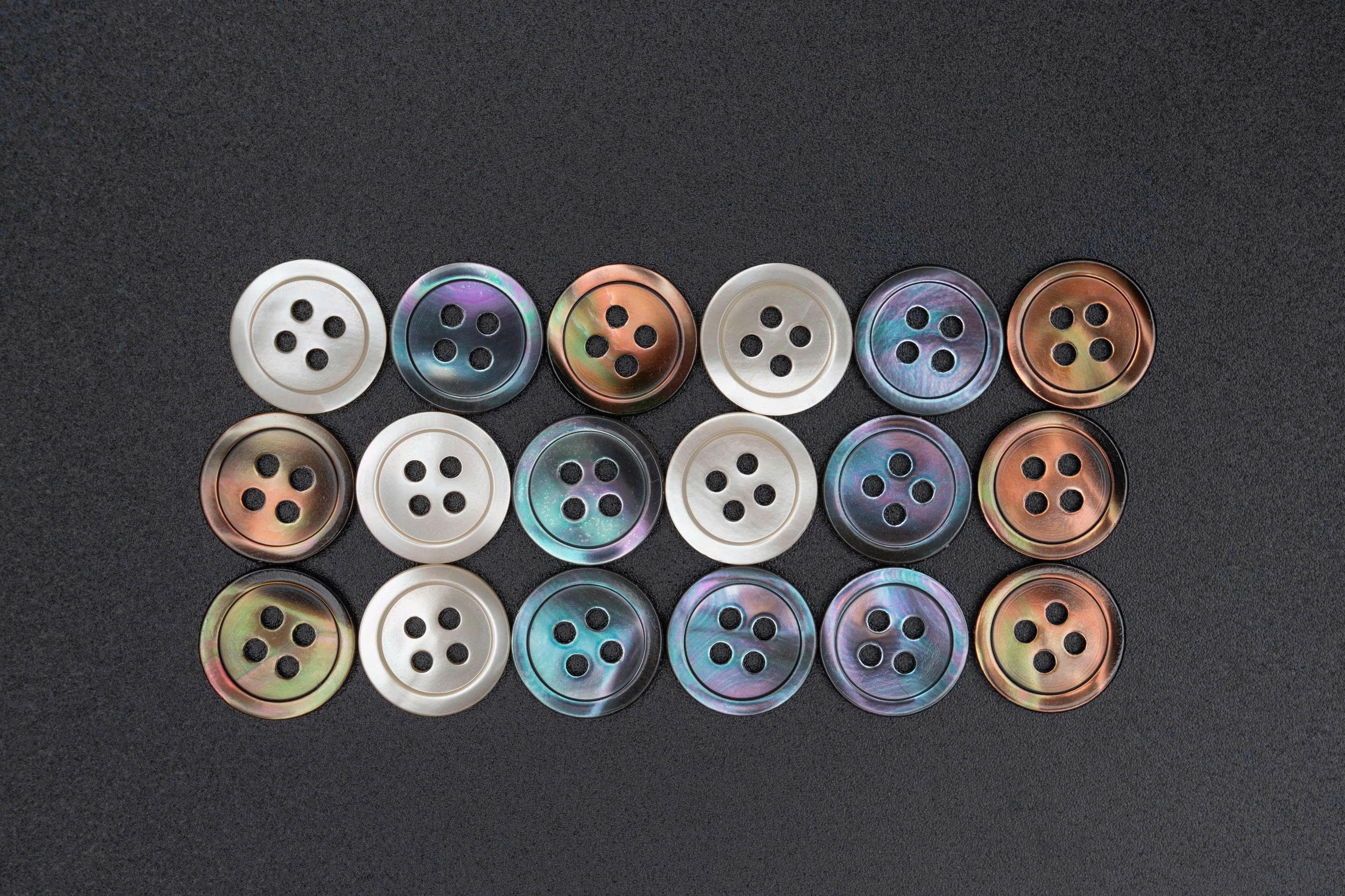
Brands should discuss the desired sorting standard with the supplier. The higher the product positioning, the clearer the sorting standard should be. If the order requires repeat production, a golden sample should be kept for future batch comparison.
MOP does not need to look 100% identical like plastic. But the variation should stay within an acceptable range so the finished shirt still looks harmonious.
QC for MOP buttons before bulk production
For MOP buttons, QC should not only ask whether the buttons look nice. The inspection should be more specific: size, thickness, hole drilling, button edge, surface quality, cracks, chipped edges, shine and color tone.
Holes should be clean and correctly positioned. Edges should be smooth so they do not feel uncomfortable in use or affect the sewing thread. The surface should not have obvious defects, especially for premium dress shirt lines.
If the brand uses MOP buttons with logo engraving, the logo clarity, engraving position and engraving depth should also be checked. A logo that is too thin or too small may not be clear on shirt button size.
A carefully approved golden sample helps reduce confusion later. With an approved standard, the supplier and the brand have the same reference point when checking bulk production.
MOQ and lead time: brands should prepare early
MOP buttons should be planned early in the product development timeline. If the brand selects a standard style, common size and regular finish, the process can be faster. But if custom thickness, logo engraving, dyed tone or special packaging is required, the lead time will be longer.
Brands should not wait until the shirt is almost ready for sewing before choosing the buttons. If the MOP sample is not approved, adjusting material, finish or thickness can affect the shirt production schedule.
A clear RFQ should include material, size, thickness, finish, quantity, color requirement, QC requirement, deadline and reference images. If an old sample is available, it should be sent so the supplier can understand the exact feeling the brand wants to keep.
For premium orders, clarifying details at the beginning usually saves much more time than fixing problems at the end.
How Tuan Hien Shell Button supports brands in choosing MOP buttons
For brands looking for Mother of Pearl buttons for shirts, the goal is not only to find a beautiful button. The brand needs to choose the right type of MOP, the right size, the right thickness, the right finish and the right QC standard for its dress shirt line.
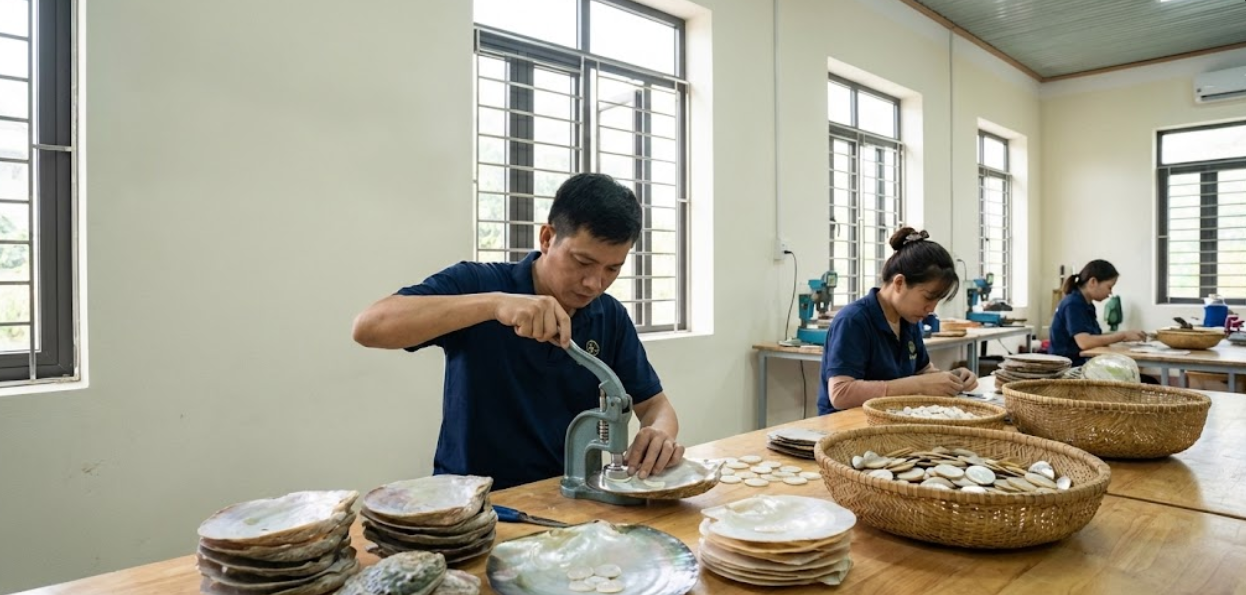
Tuan Hien Shell Button can support customers with material selection, size, thickness, finish, sample approval, QC and preparation for bulk production.
If a brand is developing premium dress shirts, MOP is worth considering when the product needs a more refined and complete feeling. When the RFQ requirements are clear, quotation, sampling and production are easier to control.
Conclusion: MOP works when the brand wants a more finished shirt
Premium brands use MOP for dress shirts because this material gives a natural, refined and well-finished feeling. But MOP should not be chosen only because it looks beautiful. Buyers still need to check size, thickness, finish, color tone, consistency, QC and production stability.
A good dress shirt does not need an overly noticeable button. It needs the right button: the right feel, the right material, the right thickness and the right brand direction.
Customers who need advice on MOP buttons for dress shirts or Mother of Pearl buttons for premium shirts can contact Tuan Hien Shell Button via HOTLINE: +84 283 9851258 for support based on real order requirements.


